
Deep Research
For questions that need more than one step. The assistant plans the study, pulls the datasets, runs a hosted notebook and writes it up with figures, tables and sources you can check.
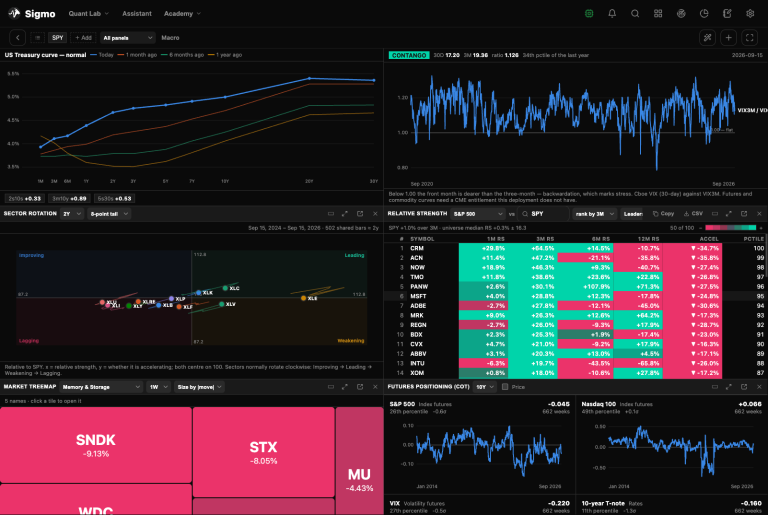
Some questions cannot be answered in one query. "How have YC companies backed by a16z performed since 2015?" or "Which sectors led in every rate-cutting cycle since 1990, and what did small caps do next?" take a plan, several datasets, real computation and a write-up. Deep Research is the assistant working that way: as a session, not a reply.
A plan, then the work
- It scopes the question first. The assistant lays out the steps it intends to take, the datasets it will use and what it will not be able to show, before it starts.
- It runs code, not vibes. Each step executes in a hosted notebook with the datasets already loaded, so numbers come from computation over real history, not from memory.
- Figures and tables are part of the answer. Charts, ranked tables and the underlying rows are produced by the notebook and shown inline, with the code kept alongside.
- Sources stay attached. Filings, announcements, prices and datasets are cited where they were used, so a reader can follow every number back.
Built to be checked
The finished study is a report, not a chat transcript: sections, captions, a deal or result table, and the notebook that produced it. Refine one section without rerunning the whole study, ask a follow-up in the same thread, or open the notebook and change an assumption yourself.
Share it, or keep it
Publish a study to the community gallery with its figures, or keep it private. Published studies are readable in full, including the code, which is what makes them worth reading.
What it can reach
Everything in the data catalogue: prices at every timeframe, fundamentals with point-in-time dates, filings and transcripts, options, short interest, institutional and insider positioning, alternative data, macro series and the private-market network of startups, investors and offering filings.
Plans
Research sessions are included on paid plans with a per-session step budget, and heavier studies can use included compute credits. Details are on the pricing page.
See it on your own watchlist
Sigmo is free to start. Open the app, ask one question about a ticker you follow, and take it from there.