
SpaceX: A bet on AI, Starship and Direct-to-Cell
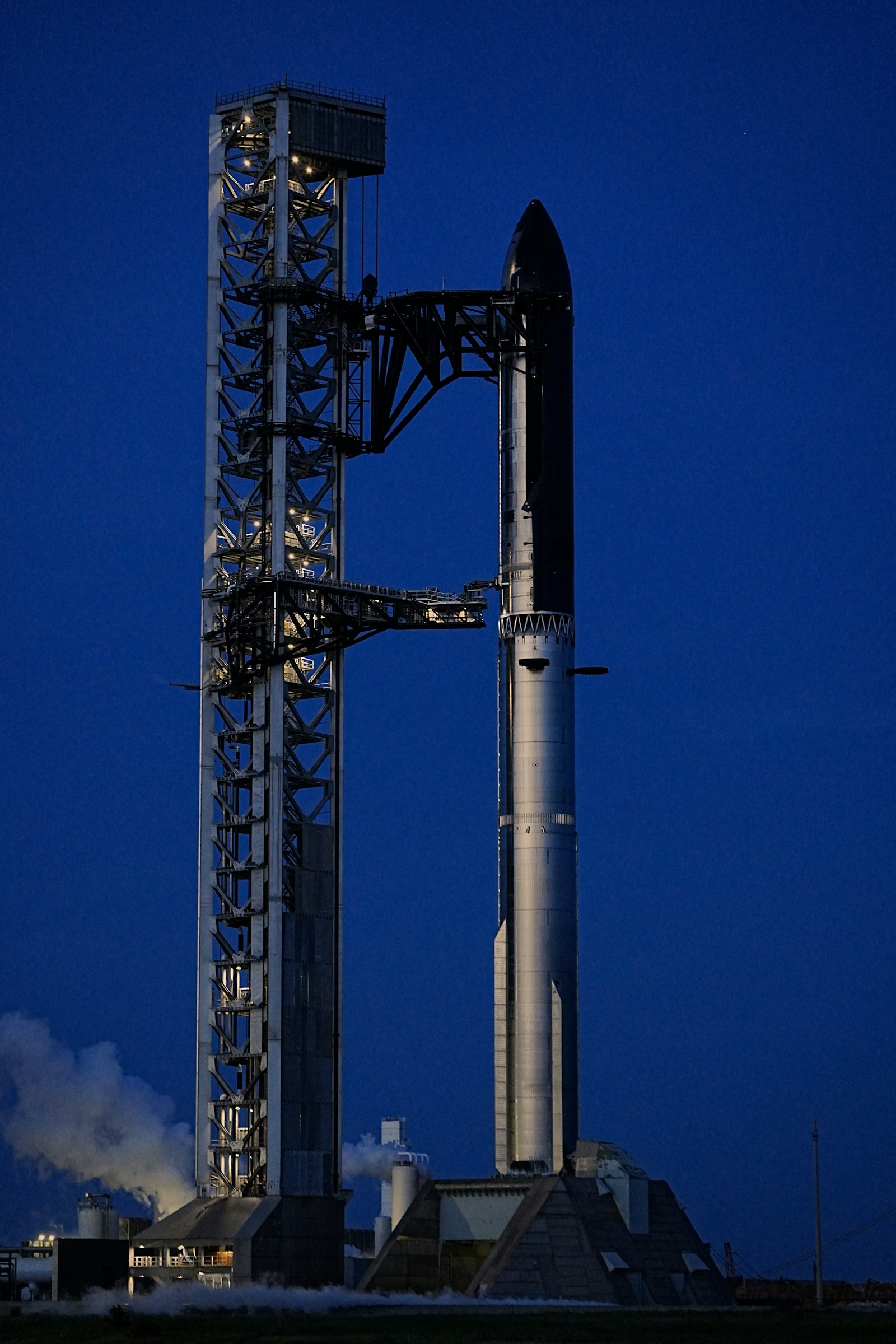
SpaceX (SPCX) beat on Q3 tonight, and the stock jumped from a $147.79 close to $159.70 after hours. We asked one question: what does a $2 trillion valuation actually require?
1. AI is now SpaceX's biggest business
- Revenue: $14.58B, up 161%. AI compute $7.56B, Starlink $5.25B, launch $1.77B.
- Profit: net income $4.4B, operating income $2.8B. Capex was $19.6B.
- Compute: 1.7 GW today. Musk is "highly confident" in 13 GW by end-2027, with 20+ GW possible.
Sources: CNBC, earnings call transcript
2. A volatile ride since the IPO
Figure 1
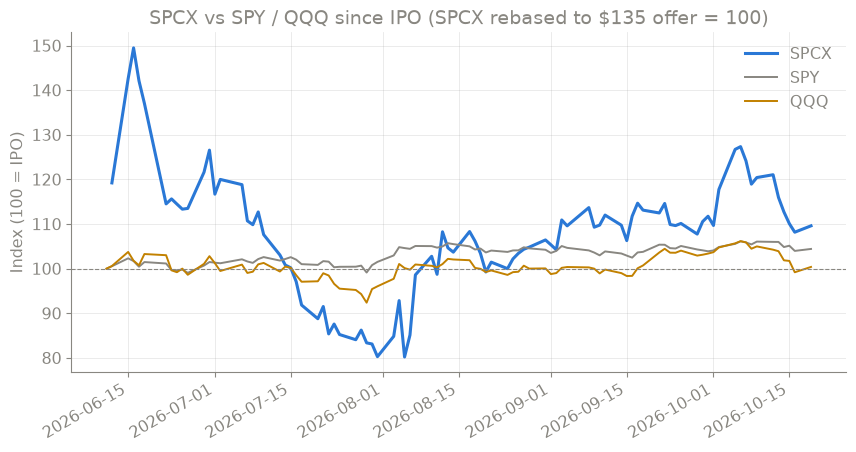
SPCX is up 10% from its $135 IPO price but down 8% from its first-day close, and 27% below its June peak of $201.80. It moves 3–4× as much as an index fund.
3. The valuation is steep
At about $2.0T, SpaceX trades at 114× annualized earnings, 33× sales and 174× operating profit. Q3 net income was well above operating income, so the P/E flatters the business — 174× is the more honest number.
4. Starlink: 100× Beast
Figure 2
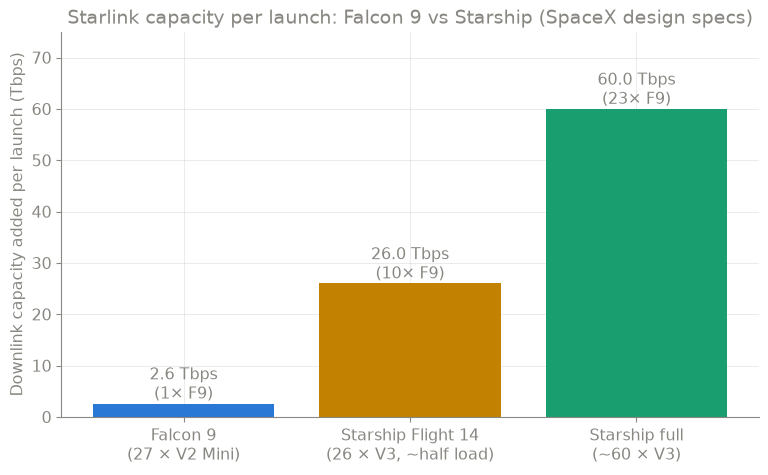
A half-full Starship added 26 Tbps of capacity, 10× a Falcon 9. Musk's bigger claim on the call: about 100× today's total Starlink bandwidth within roughly three years — satellites with 10×+ the capacity each, and around 100,000 of them in orbit. He said revenue should be "at least somewhat proportionate" to bandwidth, and sees "a clear path to several hundred billion dollars a year" in connectivity revenue, without a date (transcript).
Phones are the next big market. Starlink Mobile already reaches 22M monthly users (+37% in a quarter). New direct-to-cell satellites start flying in 2027, with full service planned for early 2028 on newly bought spectrum.
Why this matters: our base case is conservative here — Starlink revenue grows from about $21B to $58B by 2030, worth about $41 a share. If Musk is right and connectivity reaches $200B a year, Starlink alone would be worth roughly $140 a share, lifting our base case to about $220.
The catch: bandwidth only becomes revenue if people pay for it, and the price per gigabyte will fall as supply floods in. Musk's timelines also tend to slip — he has said himself that some of his claims are "aspirational."
Figure 4
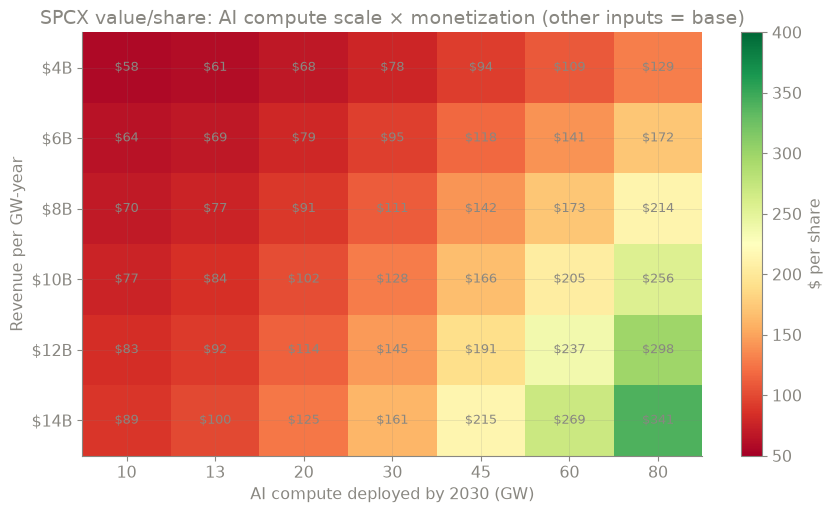
Wall Street Consensus: Wedbush $225, Evercore $275, Morgan Stanley $300, Raymond James $800 (Finbold). Analysts are effectively pricing in our bull case on AI.
7. A different lens: the long game
On October 19, Musk pledged to give one of his own SpaceX shares to every child in America in 2027 — worth over $10B at today's price — and called it "the first of many" (TechCrunch). It follows SpaceX President Gwynne Shotwell's July gift of one share to each of about 2 million children's Trump Accounts.
That changes who owns SpaceX more than what it's worth:
- No dilution: the shares come from Musk's own stake (≈ 0.5% of the company), not new stock.
- A longer horizon: a child holding a share for 10–18 years cares less about 2030 numbers and more about whether SpaceX's bigger bets — AI, Starlink everywhere, Mars — pay off over decades.
- The flip side: a mission doesn't set a stock price. The 2030 math above still decides whether today's $148 is a fair entry.
Conclusion
SpaceX had a strong quarter, but buying SPCX today isn't a bet on rockets or even Starlink. It's a bet that AI compute reaches about 3× what Musk says he's confident in. If it does, there's upside. For investors with a decades-long horizon — like the millions of kids about to become shareholders — the question shifts from "is it cheap today?" to "do you believe in where SpaceX is going?"
What to watch:
- Starlink's 100×: V3 satellites in volume by mid-2027 and phone service in 2028 — if bandwidth turns into revenue, Starlink becomes a second big growth engine.
- Pricing per GW: if compute keeps earning today's rates, each GW is worth more.
- Funding: 10 GW of Nvidia capacity costs about $400B, which could mean issuing more shares.
For research and education only, not investment advice. Scenarios are Sigmo's own assumptions, not company guidance.
Sigmo can make mistakes — verify important info. Not financial advice.
Get AlphaWeekly in your inbox
Free. New issues as they are published, with the charts and the method in view.