
Nearly Half of Earnings Beats Still Fall. Here's Why.
Five years of S&P 500 earnings beats: which winners keep sliding, and why.
Why a Stock Can Drop Even After It Beats Earnings
Three out of four big US companies "beat" Wall Street's profit forecast every quarter. Yet nearly half of those stocks still fall the next day. Here's what's really going on, in plain English.
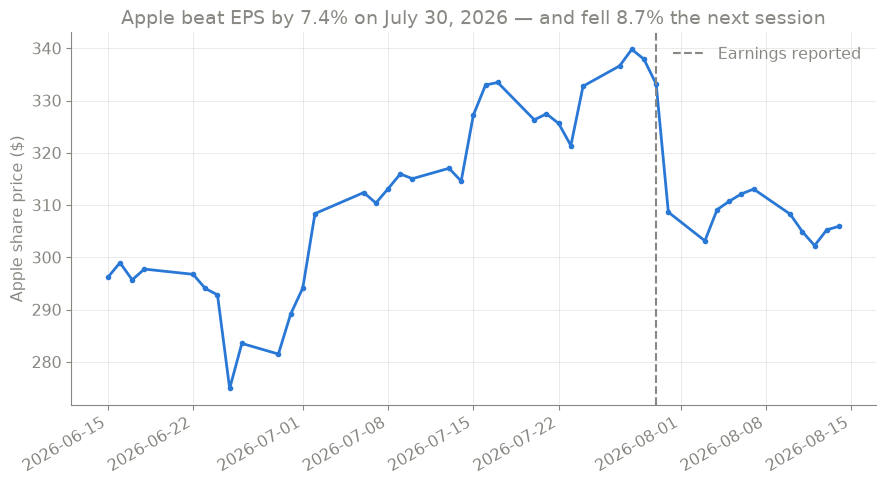
On July 30, 2026, Apple told investors it earned $2.02 per share last quarter. Wall Street had expected $1.88. That's a clear win: Apple beat the forecast by 7.4%.
The next day, Apple's stock fell 8.7%, while the overall market rose 2.4% over the same stretch.
Good report. Falling stock. If that has ever happened to a stock you own and you thought "that makes no sense," this issue is for you.
First, what does "beating earnings" mean?
Every three months, public companies report how much money they made. The number everyone watches is earnings per share (EPS): the company's profit divided by its number of shares. Think of it as how much profit each single share "earned."
Before the report, Wall Street analysts publish their best guess for that number. If the company comes in above the guess, headlines say it "beat." Below it, it "missed."
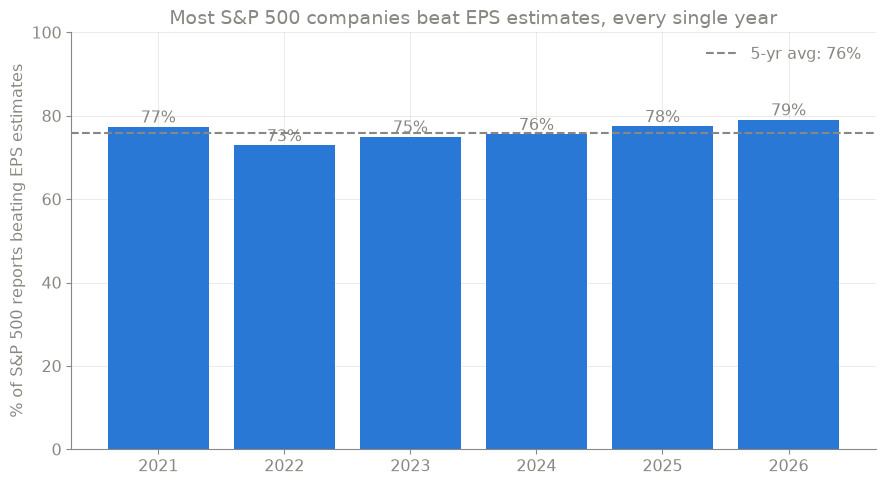
Here's the surprise: beating is normal. We looked at 10,686 earnings reports from S&P 500 companies over the past five years. 76% beat the forecast, and in no single year did fewer than 73% beat.
Why so many? Companies talk with analysts all the time and tend to set expectations they know they can clear. Picture a teacher who sets the "expected score" at 70 when most of the class usually scores 80. Clearing the bar isn't news. How far you clear it, and what you say about next term, is.
A beat helps, but less than you'd think
So does beating help the stock? Yes, but not by much, and not reliably:
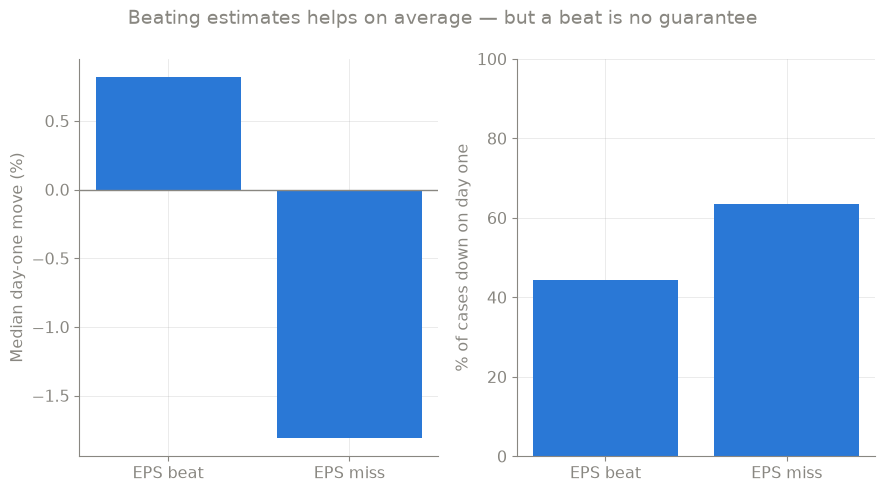
- Companies that beat: the typical stock rose 0.8% the next day, but 44% still fell.
- Companies that missed: the typical stock fell 1.8%, and 64% fell.
(By "typical" we mean the middle result: half did better, half did worse. The few remaining reports matched the forecast exactly.)
In other words, a beat tilts the odds in your favor, but it's no guarantee. Roughly 2 out of every 5 beats still end the next day in the red.
Seven reasons a good report can still sink a stock
1. The beat was too small. Imagine a friend promises to bring "something nice" to dinner and shows up with one cookie. Technically true, still disappointing. Investors often carry an unofficial, higher expectation (traders call it the "whisper number"), and a thin beat can fall short of it. Netflix beat its forecast by just 1.3% on July 16, 2026 and fell 6.4% the next day. The market fell 1.5% that day, so Netflix dropped more than four times as much.
Check next time: how big was the beat, in percent?
2. Management sounded cautious about what's next. An earnings report looks backward: it covers the last three months. A stock price looks forward, often years ahead. So when management's forecast for the coming months (called "guidance") sounds weak, it can outweigh a good quarter. UPS beat by 6.7% on July 28, 2026 and fell 7.4% the next day. The market dipped only 1.3%, and UPS hadn't run up much beforehand (+3%), so neither explains the drop. When the numbers look fine and the stock still falls hard, the answer usually lies in what management said about the future.
Check next time: what did the company say about next quarter, not just last quarter?
3. The beat was "low quality." Profit can go up even while the business shrinks, for example by cutting costs, laying people off, or buying back shares (fewer shares means each one "earns" more, even if total profit is flat). It's like a restaurant making more money this month by letting a cook go: nice for now, but not a sign of a growing business. Comcast beat by 7.2% on July 23, 2026, but its sales went from growing 5.3% to shrinking. The stock fell 5.2%.
Check next time: did sales grow too, or did the beat come from cost-cutting?
4. It missed the one number investors really watch. Every company has a "report card" line that matters more than profit. For stores, it's same-store sales (are existing stores selling more?). For streaming services, it's subscribers. For software companies, it's cloud growth. Target beat its profit forecast by only 1% on August 20, 2025, alongside weak store sales, and fell 7.9% the next day.
Check next time: what's this company's key number, and did it hold up?
5. The good news was already "priced in." If a stock climbs a lot before the report, investors have already bet on good results. When those results arrive, some cash out: "buy the rumor, sell the news." It's like a movie so hyped that a merely great film feels like a letdown. Meta rose 27.7% in the month before its April 29, 2026 report, beat by 7.2%, and still fell 8.9% while the market rose 1.0%. Apple, our opening example, had also climbed 20% in the month before its report.
Check next time: how much did the stock already rise in the weeks before?
6. Big spending plans made investors nervous. A company can beat on profit and then announce it will spend far more in the future, which means less profit left over later. In recent years, big tech companies have announced huge spending on AI data centers, and investors have repeatedly worried about when it will pay off. Microsoft beat by 4.4% on April 29, 2026, after a 20% run-up, and fell 5.0%, in line with that pattern.
Check next time: is the company planning to spend much more than expected?
7. The whole market fell that day. Sometimes it isn't about the company at all. GE beat by 8.6% on July 16, 2026 and fell 3.2%, but the S&P 500 fell 1.5% that same day. About half of GE's drop was simply the market, not GE.
Check next time: were the overall market or the company's competitors also down?
The examples at a glance
| Company | Report date | Beat by | Stock next day | S&P 500 | Run-up in prior month | Likely reason |
|---|---|---|---|---|---|---|
| Apple | Jul 30, 2026 | 7.4% | −8.7% | +2.4% | +20.0% | Priced in |
| Netflix | Jul 16, 2026 | 1.3% | −6.4% | −1.5% | −8.3% | Beat too small |
| UPS | Jul 28, 2026 | 6.7% | −7.4% | −1.3% | +3.3% | Cautious outlook |
| Comcast | Jul 23, 2026 | 7.2% | −5.2% | −1.1% | +6.8% | Sales shrinking |
| Target | Aug 20, 2025 | 1.0% | −7.9% | −0.7% | +4.7% | Key metric missed |
| Meta | Apr 29, 2026 | 7.2% | −8.9% | +1.0% | +27.7% | Priced in |
| Microsoft | Apr 29, 2026 | 4.4% | −5.0% | +1.0% | +20.0% | Spending worries |
| GE | Jul 16, 2026 | 8.6% | −3.2% | −1.5% | — | Market fell |
Stories vs. statistics: what holds up across 8,000 beats
Individual stories are memorable, but they can mislead. So we tested several of these reasons across all 8,108 beats in our data:
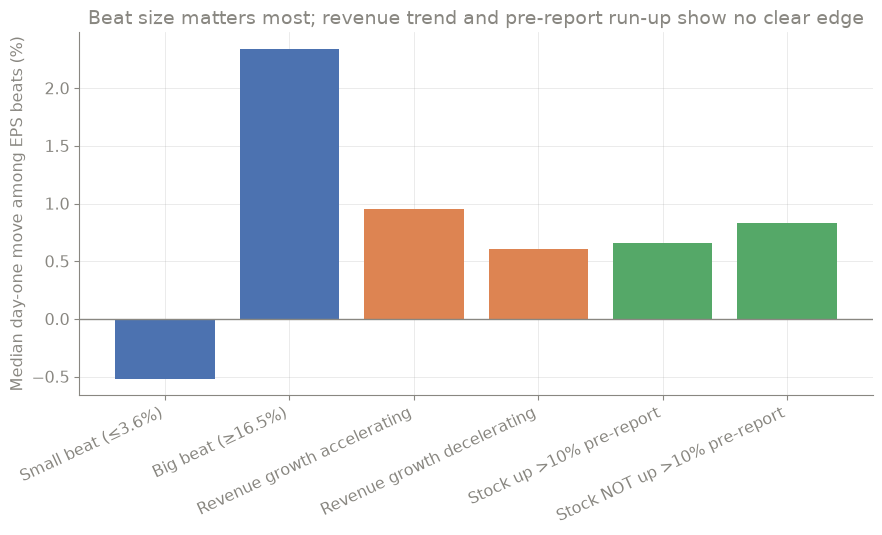
- Size matters, a lot. Big beats (the top quarter, 16.5% or more above forecast) rose a typical 2.3% the next day. Small beats (the bottom quarter, 3.6% or less) fell a typical 0.5%. A gap of almost 3 percentage points is far too big to be luck. A razor-thin beat often gets treated like a miss.
- Sales trend: no clear pattern. Beats where sales growth was speeding up did only slightly better than those where it was slowing (+0.9% vs. +0.6%), too small a difference to count.
- Big run-up beforehand: no clear pattern. Stocks that jumped more than 10% in the month before reporting moved about the same as everyone else (+0.7% vs. +0.8%).
- Guidance: couldn't measure. Reliable data on company forecasts wasn't available, so we can't put a number on it.
Wait, didn't Meta and Apple just show that run-ups matter? Here's the honest lesson: a reason can explain one stock's drop without being a reliable rule across hundreds of companies. The stories tell you what to look for. The data says not to treat any single one as a sure thing, except beat size, which shows up clearly across the board.
Next time a stock you own beats and drops, check these 5 things
- How big was the beat? A 1% beat and a 15% beat are very different news.
- Did sales grow too? Or did profit rise only because of cost cuts, buybacks, or a one-time gain?
- What did management say about the next few months? The forecast often matters more than the past quarter.
- Had the stock already jumped before the report? If so, the good news may have been priced in.
- Was the whole market or industry down that day? Then the drop may have little to do with the company.
The bottom line
"Beat earnings" sounds like a big win, but three in four companies do it every quarter, so on its own it tells you very little. What moves the stock is how big the beat was, how healthy the numbers behind it are, and what the company says about the future. A beat-and-drop isn't automatically a sign that something is wrong. Run through the checklist before you react.
About this study: 10,686 S&P 500 quarterly earnings reports, September 2021 to September 2026, measuring the stock's move on the next trading day. "Typical" means the median (middle) result. Differences were only called meaningful if they passed a statistical test for luck.
For information only, not investment advice. Past patterns don't guarantee future results.
Sigmo can make mistakes — verify important info. Not financial advice.
Get Market Watch in your inbox
Free. New issues as they are published, with the charts and the method in view.