
Why Old Car Stocks Barely Grew, and Why Tesla Did
Why Old Car Stocks Barely Grew, and Why Tesla Is Worth So Much More
Ford has been building cars for more than 120 years. So why has its stock gone almost nowhere? And why is Tesla worth more than the biggest traditional automakers combined, even now that they all sell electric cars too?
What we wanted to find out
Many new investors notice three things about car stocks, and we set out to test each one with real data:
- "Car stocks are cheap." Most trade under $100 a share. Does that mean the companies are small or bargains?
- "Old car companies' stocks barely grew." Is that true once you count the dividends they pay?
- "Tesla is worth far more than everyone else." Why, if rivals now make electric cars too?
Spoiler: the answers all come back to one simple idea about what a stock price really measures.
Myth #1: A low share price means a cheap company
Ford's stock costs about $12. Toyota's US-traded share costs about $188. So is Toyota the "expensive" one?
Not really. A share price depends on how many pieces a company is cut into. Think of a pizza: cut it into 4 slices or 40 slices, and it's still the same pizza. The slices from the 40-slice pizza are just cheaper.
Ford is cut into billions of slices, so each one is cheap. Toyota's US share actually bundles 10 Japanese shares together, which makes it look pricier. Tesla has split its stock twice since 2020 (cutting its pizza into more slices), or each share would cost many times more.
What matters is the whole pizza: the company's total value, called market value (share price × number of shares). By that measure, Ford is worth about $50 billion. Tesla is worth about $1.4 trillion.
Lesson: never judge a company by its share price. Compare market values.
Part 1: Did old car stocks really barely grow?
To answer fairly, we looked at total return: the stock's price change plus all the dividends paid out, reinvested back into the stock. Dividends are cash payments companies send to shareholders, and car companies pay a lot of them.
Here's what $1,000 invested in September 2003 grew to by today:
Growth of $1,000
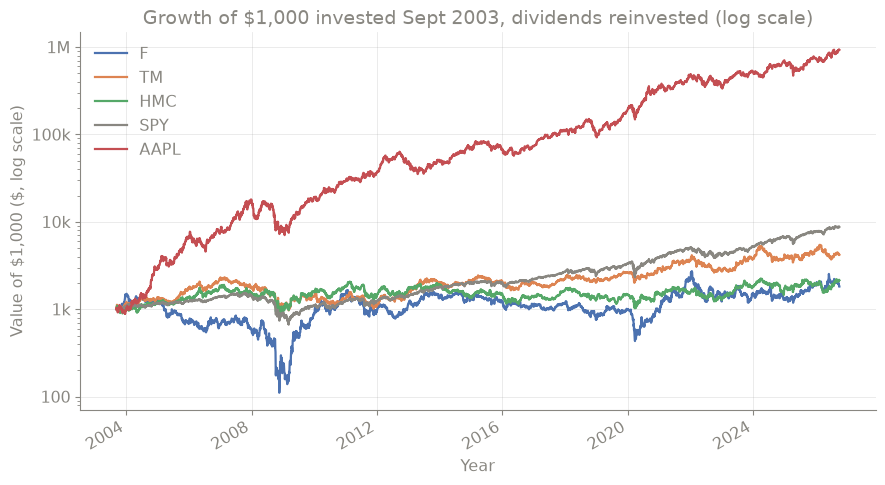
Figure 1: With dividends reinvested, $1,000 in Ford grew to about $1,800 since 2003, while the same $1,000 in the S&P 500 grew to about $8,700.
| Investment | Yearly return (with dividends) | $1,000 grew to |
|---|---|---|
| S&P 500 | 9.9% | $8,741 |
| Toyota | 6.4% | $4,208 |
| Honda | 3.4% | $2,145 |
| Ford | 2.6% | $1,819 |
Table 1: Every legacy automaker trailed the overall stock market over the same 23 years, even with dividends included. September 2003 to today.
Verdict: mostly true. Old car stocks did grow a little, and dividends helped. But they fell far behind simply owning the whole market.
Why? Three reasons
1. Profits barely grew. A stock price is really a bet on a company's future profits. If profits don't grow, the stock usually doesn't either. Ford's yearly sales rose only about 24% in ten years, from $153 billion in 2016 to $190 billion in 2025. GM's operating profit (what's left after the costs of running the business) was actually lower in 2025 than in 2016: $8.1 billion vs. $9.9 billion.
2. Profits are thin. Building cars is expensive: giant factories, steel, parts, workers, and billions to design each new model. Competition keeps prices down. So car companies keep only a few dollars from every $100 of sales.
Profit kept from each $100 of sales
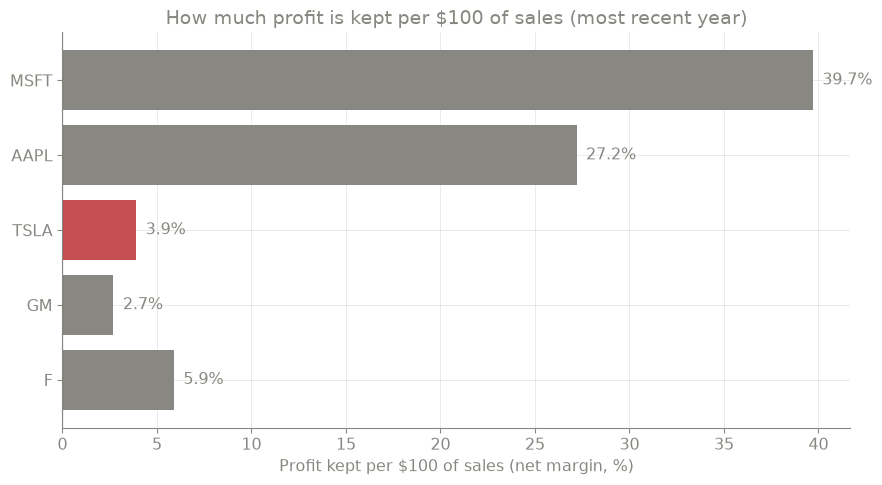
Figure 2: Car companies, including Tesla, keep roughly $3 to $6 of profit from every $100 of sales. Apple and Microsoft keep $27 to $40.
3. The cash goes back to shareholders instead of into growth. Ford pays out about 60% of its profits as dividends. GM has spent heavily buying back its own stock, shrinking its number of shares by about 42% since 2016 (from 1.6 billion to 933 million). That rewards shareholders, but it's what mature companies do when they don't see big growth ahead. Think of a steady rental property that pays you every month rather than a startup that might become huge.
Part 2: Why is Tesla worth so much more?
In 2015, Tesla was worth about $31 billion, a small fraction of the big legacy automakers combined. Today it's worth about $1.4 trillion, more than ten times Ford and GM combined. And that gap grew even as Ford, GM, Toyota and others launched their own electric cars.
It's not because of today's profits
Look back at Figure 2. Tesla keeps about $3.90 from every $100 of sales, right in the same range as Ford and GM, and nowhere near Apple or Microsoft. If you judged Tesla only by how profitable it is today, you would never guess it's worth so much more.
It's because of expected future profits
Investors can pay a lot or a little for each dollar a company earns. That's measured by the P/E ratio (share price ÷ profit per share). A higher P/E means investors expect big profit growth ahead.
What investors pay per $1 of profit
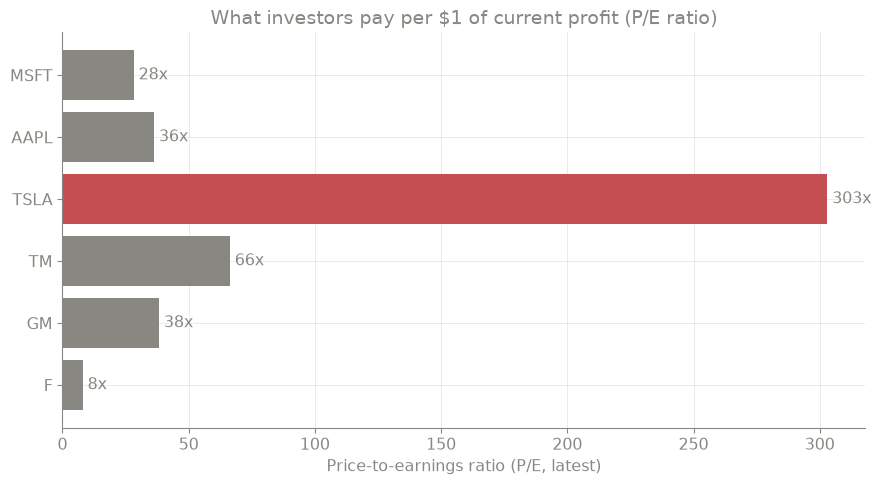
Figure 3: Investors pay about $303 for every $1 of Tesla's yearly profit, compared with about $8 for Ford. That gap is a bet on Tesla's future growth.
Why would anyone pay that much? Partly because Tesla has grown fast before: its yearly sales jumped from about $6 billion in 2016 to about $96 billion in 2025, more than fifteen times bigger, and it went from losing money to making a profit. Investors are betting that growth continues, and that new businesses like self-driving cars, robotaxis, robots and energy storage will one day earn much fatter profits than selling cars.
Think of it like paying extra for a single restaurant because you believe it will become a national chain. You're paying for the future, not today's dinner service.
Car company or tech company? Both sides
The case that Tesla is a car company: in its latest quarter, about 73% of Tesla's revenue came from selling and leasing cars, 16% from services, and 11% from energy storage. Its robots and self-driving ambitions don't yet show up as a separate business in its results. By the numbers, Tesla still makes its living selling cars.
The case that Tesla is valued like a tech company: investors pay a price for its profits that's normal for fast-growing tech companies and unheard of for carmakers. Meanwhile, rivals' electric-car businesses are still small: Ford's EV unit brought in about $7 billion in 2025, a small slice of Ford's roughly $190 billion in total sales, and Ford has reported losses from that unit.
Our take: Tesla makes money like a car company but is valued like a tech company. The gap between the two is the bet investors are making.
That bet cuts both ways
Stocks priced on big expectations can fall hard when doubts creep in. Since 2020, Tesla's stock has at one point fallen about 74% from its peak, a bigger drop than Ford (57%), GM (59%) or the S&P 500 (34%). Newer EV makers show the downside even more clearly: Rivian and Lucid have fallen about 95% and 99% from their peaks as their growth took longer than hoped.
The one idea behind everything
Stock prices follow expected profit growth. Not a company's age, fame or size, and not just whether it makes electric cars.
- Old automakers: big companies with thin, slow-growing profits, so investors pay little for each dollar they earn, and the stocks move slowly.
- Tesla: modest profits today, but investors expect huge growth, so they pay a lot for each dollar it earns, and the stock swings wildly.
What this means for you
- Don't judge a stock by its share price. Compare market values.
- Look at total return, not just price. Dividends count.
- Ask "will profits grow?" not "is it a famous company?"
- A high P/E means high expectations. Great if they come true, painful if they don't.
How we checked this: Returns use data from September 2003 to today with dividends reinvested, compared with the S&P 500 over the same dates. GM and Tesla are left out of the return table because their current stocks began trading in 2010. Profit per $100 of sales uses each company's most recent full year of net profit. Share prices, market values and P/E ratios are as of late September 2026.
For information only, not investment advice. Past performance doesn't guarantee future results.
Sigmo can make mistakes — verify important info. Not financial advice.
Get Market Watch in your inbox
Free. New issues as they are published, with the charts and the method in view.