
Are Leveraged Funds Really Bearish on US Tech? The Data Says Not Anymore.
Nasdaq positioning turned sharply bearish in August, but by September leveraged-fund positioning had moved back to net long — and history suggests crowded shorts have not necessarily been bearish for forward returns.
The main finding: The claim that leveraged funds are becoming increasingly bearish on US tech is outdated at the latest snapshot. Positioning swung sharply from long in late 2025 to short in August 2026, but by September it had moved back to net long.
Even at the August trough, positioning was bearish but nowhere near the historical record. And historically, heavily short Nasdaq positioning has often been followed by stronger, not weaker, forward returns.
Figure 1
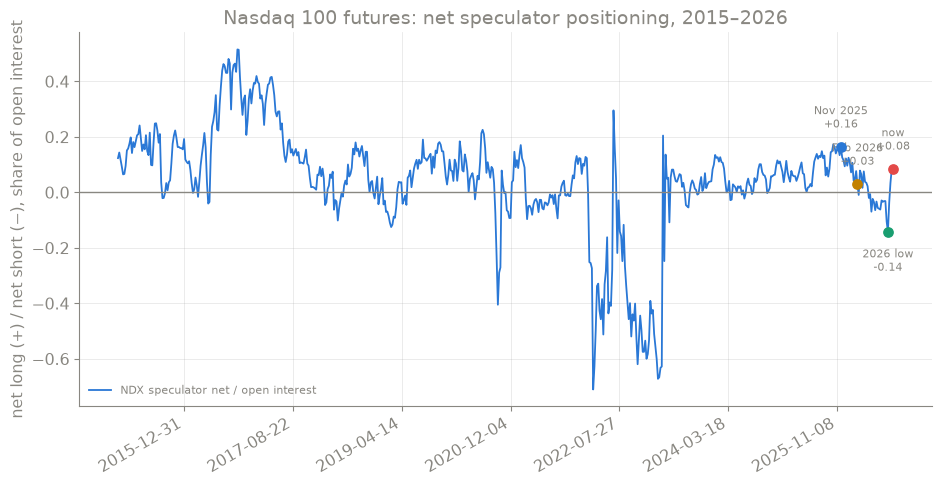
From bullish to bearish — and back again
The positioning reversal was real, but it did not persist:
- Nov 2025: +0.164 — net long
- 14 Aug 2026: -0.142 — 2026 low
- 11 Sep 2026: +0.085 — net long again
- Series record low: -0.710 — March 2022
The key distinction is between the direction of the earlier move and the current positioning level. Funds became significantly more bearish into August, but the latest reading shows that trade partially reversing.
Figure 2
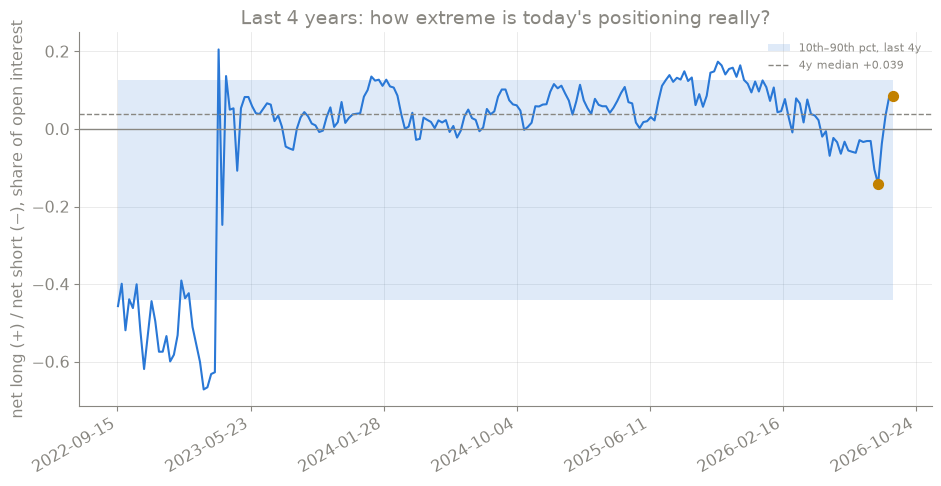
How extreme was the bearish positioning?
Bearish, yes. Record bearish, no. The August trough ranked around the 13th percentile of the last four years and the 9th percentile of observations since 2015.
By September, however, the +0.085 reading had recovered to roughly the 76th percentile of the four-year distribution — much closer to ordinary-to-slightly-bullish positioning than an extreme short.
Calling the current setup “record bearish” therefore overstates what the positioning data shows.
Figure 3
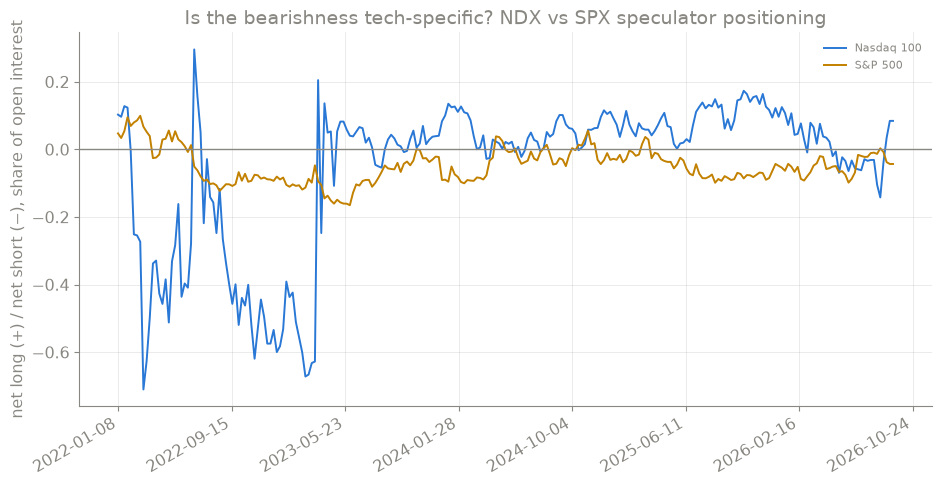
Tech isn't being singled out
The cross-index comparison weakens the idea that leveraged funds are making a uniquely bearish bet against technology.
- Nasdaq 100: +0.085
- S&P 500: -0.043
At the latest snapshot, speculative positioning was actually more bearish on the S&P 500 than on the Nasdaq 100. The two positioning series have also shown very little correlation since 2022 (≈0.01), suggesting they should not be treated as one broad risk-off trade.
Figure 4
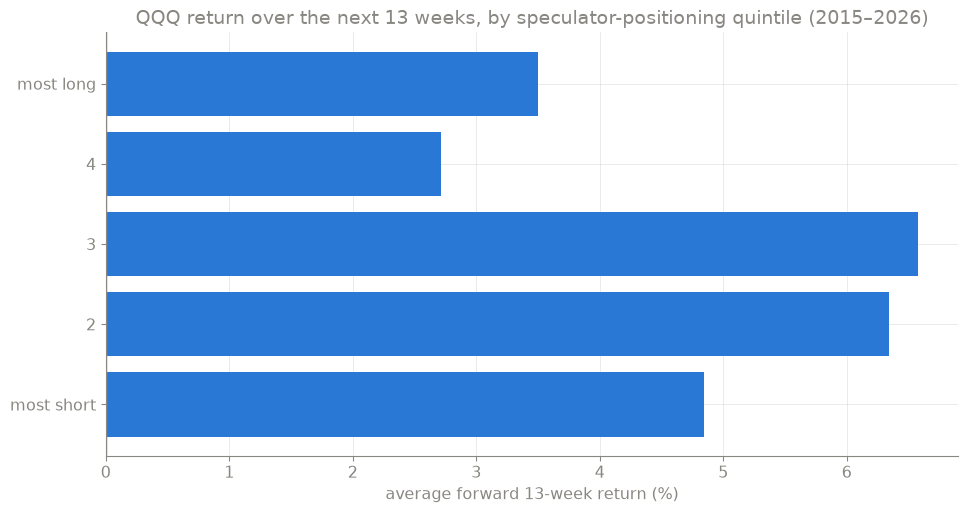
The counterintuitive part: crowded shorts historically did better
Positioning alone has not been a reliable bearish signal for future Nasdaq returns. In this sample:
- Most-short quintile: Nasdaq averaged +4.8% over the following 13 weeks.
- Most-long quintile: Nasdaq averaged +3.5% over the following 13 weeks.
In other words, the periods with the heaviest speculative shorts historically produced stronger average forward returns than the periods with the heaviest longs.
The latest reading sits in the middle positioning bucket rather than either extreme. Historically, that middle bucket has also been among the better-performing groups.
The takeaway: Positioning became meaningfully bearish in August, but that move has already reversed substantially. More importantly, bearish futures positioning by itself has not historically translated into weak forward Nasdaq performance. Positioning is better viewed as a measure of crowding and potential fuel for future moves than as a standalone directional forecast.
Sigmo can make mistakes — verify important info. Not financial advice.
Get AlphaWeekly in your inbox
Free. New issues as they are published, with the charts and the method in view.