
Beer consumption is declining — but brewers are adapting
Falling volumes are reshaping the beer industry, but pricing, premiumization and cash generation show the financial impact is far from uniform.
```html
The key finding: beer consumption is under structural pressure, but lower volumes have not translated directly into collapsing revenue or cash flow.
- Mainstream beer volumes are flat or declining across many mature markets.
- Brewers are responding with higher pricing, fewer promotions and greater emphasis on premium brands.
- Revenue has remained comparatively resilient even as unit volumes weaken.
- The financial impact varies sharply by company: STZ remains the strongest cash generator, while TAP and SAM show more pressure in different areas.
Pricing and premiumization are cushioning the decline
Beer consumption has weakened over the past 5–10 years in several major markets, yet brewer revenue has held up better than unit volumes would suggest.
The reason is straightforward: companies are selling fewer units at higher realized prices while shifting their portfolios toward more profitable premium products.
- Volumes have declined across parts of the mainstream beer category.
- Pricing increases help offset fewer units sold.
- Premium and imported brands improve mix and revenue per unit.
- Productivity programs and cost controls help protect margins.
This creates an important distinction: declining beer consumption does not automatically mean declining brewer economics.
Figure 1
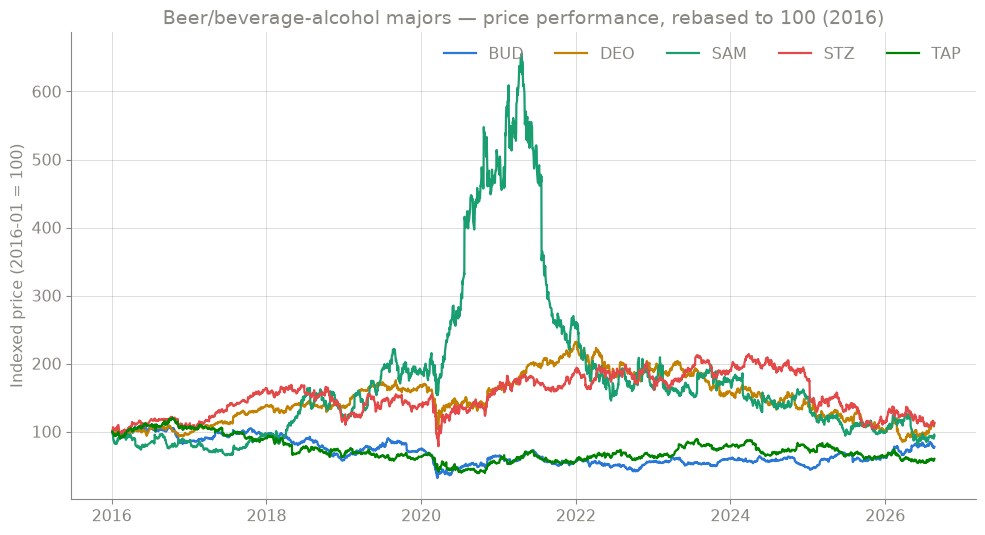
Figure 2
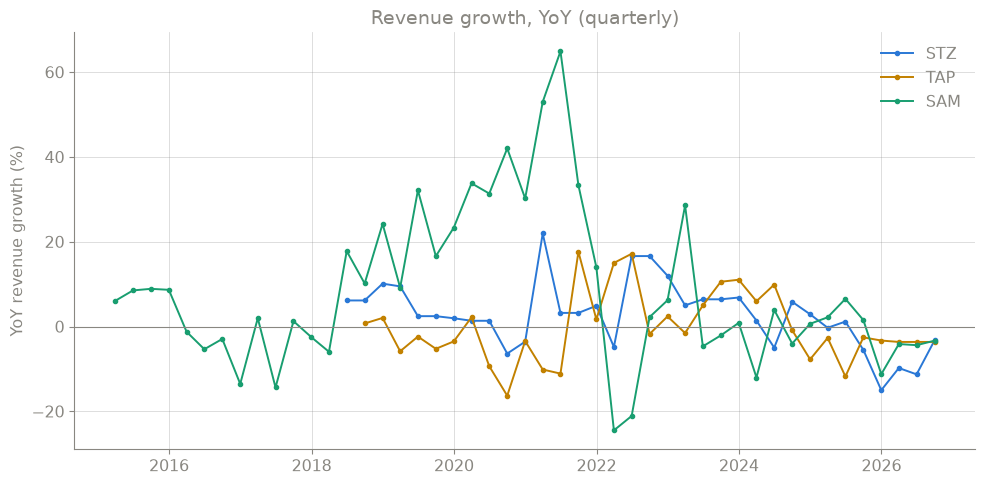
Revenue tells the same story. STZ's relative strength is heavily supported by Modelo and Corona, while TAP and SAM more clearly reflect the slower-growth economics of mature beer categories.
Average quarterly YoY revenue growth remains modest across the group, reinforcing the idea that pricing and mix are offsetting weakness rather than creating a new high-growth cycle.
Cash generation separates the winners
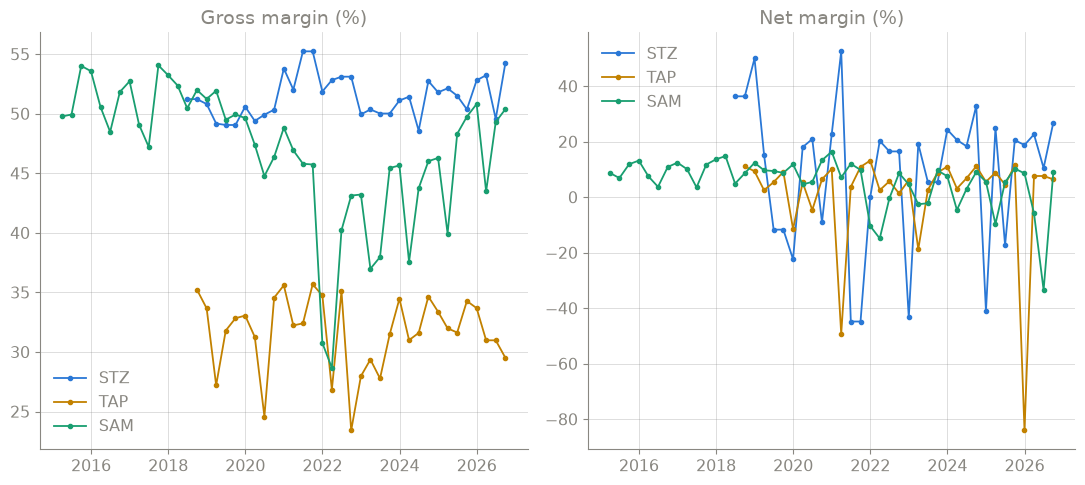
Revenue alone does not show which brewer is handling the volume slowdown best. Free cash flow and margins provide a clearer picture of underlying operating strength.
- Constellation Brands (STZ): $1.83B of TTM free cash flow, up roughly 9% YoY. Its premium beer portfolio gives it the strongest cash-generation profile in the group.
- Molson Coors (TAP): $961M of TTM free cash flow, down roughly 20% YoY. The company remains highly cash generative, but recent margin and cash-flow trends are softer.
- Boston Beer (SAM): $206M of TTM free cash flow, up roughly 14% YoY. Its cash base is much smaller, but recent free cash flow remains positive.
Bottom line: STZ stands out on absolute cash generation, while TAP and SAM illustrate that the same industry-wide volume pressure can produce very different financial outcomes.
Figure 3
GAAP earnings can obscure the operating picture
Headline earnings can be misleading when analyzing brewers. GAAP EPS is often affected by impairments, tax items, restructuring charges and share repurchases that do not necessarily reflect changes in the underlying beer business.
For that reason, free cash flow and gross-margin trends can provide a cleaner view of operating health than a single period of reported EPS.
Figure 4
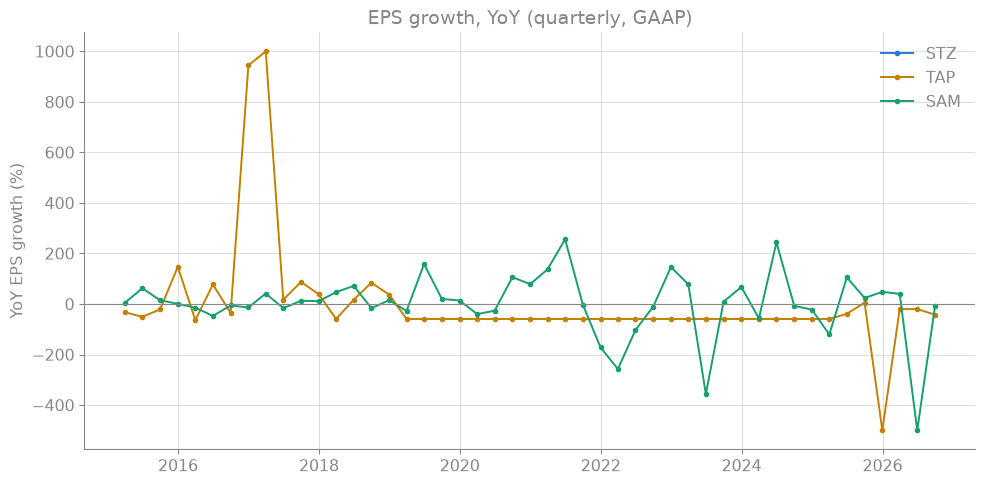
TAP is a good example. Its large negative EPS print was influenced by an impairment rather than an equivalent deterioration in the operating business.
That does not mean the underlying trend is strong — TAP's recent free cash flow and margins have weakened — but it demonstrates why headline EPS should be separated from recurring operating performance.
SEC-XBRL verified financials
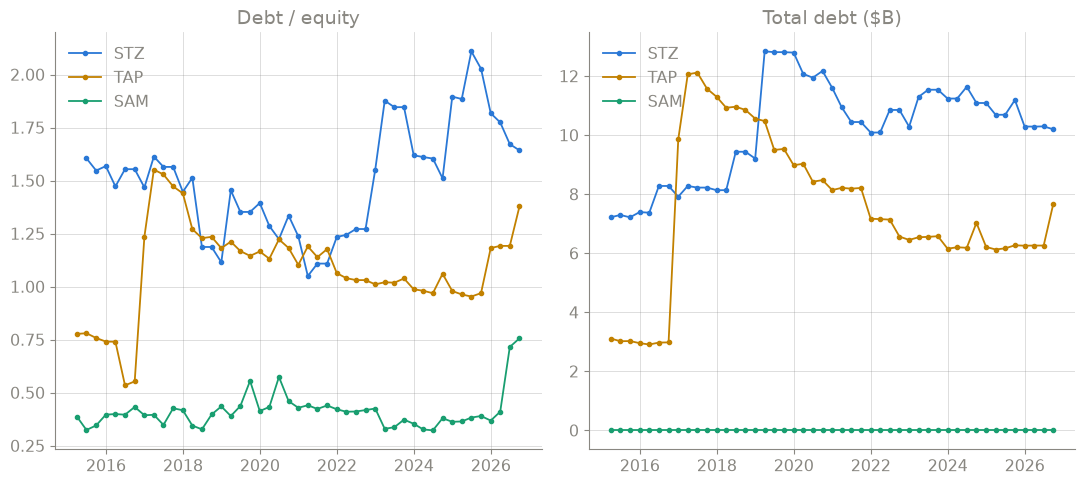
The company-level analysis uses point-in-time SEC-XBRL financials for Constellation Brands (STZ), Molson Coors (TAP) and Boston Beer (SAM). AB InBev (BUD) and Diageo (DEO) are excluded from these verified tables because they report under IFRS through 20-F filings.
Figure 5
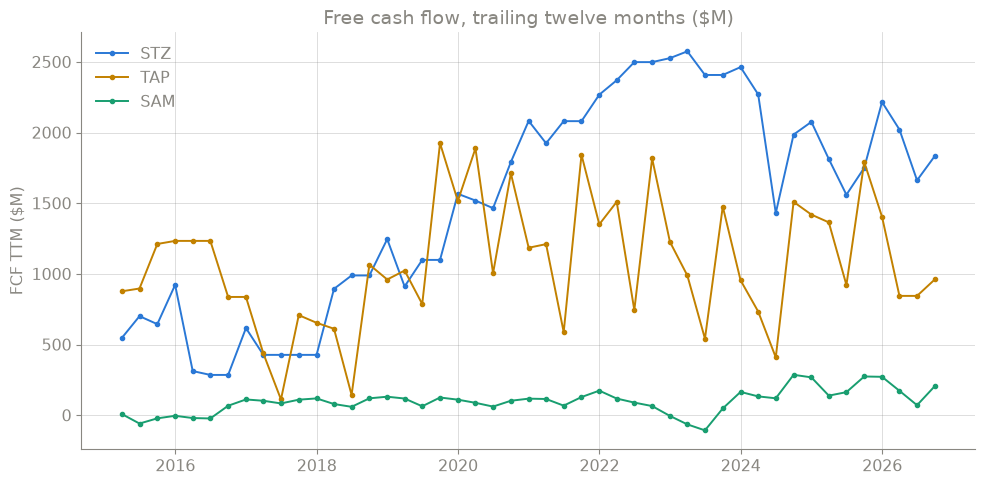
Figure 6
Company-level operating trends
- STZ: gross margin moved from 51.34% to 51.25%, essentially flat, while latest FCF increased 9.05% YoY.
- TAP: gross margin declined from 32.46% to 31.27%, while latest FCF fell 19.76% YoY.
- SAM: gross margin declined from 50.61% to 43.79%, although latest FCF still increased 13.56% YoY.
The divergence is important.
- STZ: the cleanest operating picture — margins are broadly stable and cash flow is growing.
- TAP: remains cash generative, but margin compression and weaker recent FCF suggest greater pressure.
- SAM: margins have weakened materially, although cash generation has remained resilient.
The sector therefore cannot be reduced to a simple "beer consumption is falling, therefore brewer profits are falling" thesis.
Latest verified TTM free cash flow
STZ: $1.83B (+9% YoY) · TAP: $961M (-20% YoY) · SAM: $206M (+14% YoY)
STZ is the clear leader in absolute cash generation, while the direction of cash flow at TAP and SAM highlights the different ways brewers are absorbing the industry's volume pressure.
Figure 7
Valuation context
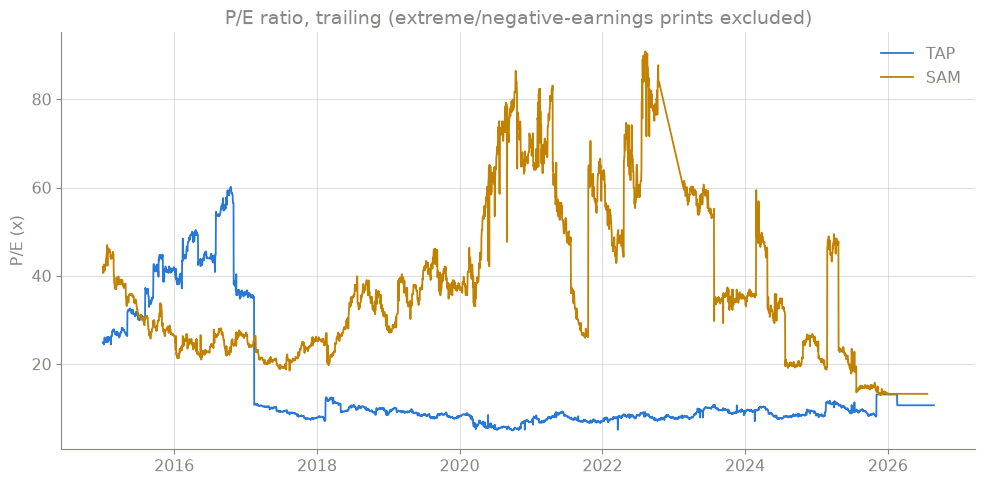
TAP — current 10.7 vs. a five-year range of 5.1–13.1 and median of 8.9.
SAM — current 239.2 versus a five-year median of 34.0.
The dispersion suggests the market is not treating brewers as one homogeneous group. Expectations around growth, profitability and future earnings differ substantially by company.
So, is falling beer consumption actually hurting earnings?
Yes — but less dramatically than the volume data alone might suggest.
Pricing, premiumization and productivity have absorbed much of the pressure so far. The bigger question is how long those offsets can continue if volumes keep declining.
What happens from here?
Three scenarios frame the industry's path from here:
- Bull case: volume declines slow, premiumization continues and pricing remains effective. Revenue holds up and margins stabilize or expand.
- Base case: low-single-digit volume declines persist, but pricing and mix continue to offset most of the impact. Revenue stays roughly stable and margins remain manageable.
- Bear case: volumes decline faster while consumer resistance limits further price increases. Fixed costs become harder to absorb and margins compress.
Final verdict
The thesis that "beer is structurally dying" is directionally right on consumption, but incomplete as an investment thesis.
Volumes are under pressure, yet premiumization, pricing and cost discipline have allowed parts of the industry to remain highly cash generative. STZ currently shows the strongest combination of margin stability and cash generation. TAP appears more pressured operationally, while SAM continues to generate cash despite weaker margins.
The real risk is not simply that people drink less beer. It is that volume declines eventually become too large for pricing and premium mix to offset. That is the threshold investors should watch.
```
Sigmo can make mistakes — verify important info. Not financial advice.
Get AlphaWeekly in your inbox
Free. New issues as they are published, with the charts and the method in view.