
Who backs the most YC companies?
Getting into Y Combinator is hard. Landing on a top venture firm's public portfolio page afterward is rarer still. YC has backed more than 6,000 companies since its first batch in 2005, and only a little over 500 of them appear on the published portfolios of the 12 firms we tracked. That's roughly one in twelve.
Those 12 firms include Andreessen Horowitz (a16z), Initialized, General Catalyst, Accel, Sequoia, First Round, Peak XV, Bessemer, Greylock, Kleiner Perkins and Khosla. The companies on these lists share a clear pattern. They skew toward business software, they come mostly from YC's earlier years, and they have done noticeably better than YC as a whole. One firm stands well above the rest. Outside our data, there are also signs that hardware, the one sector these lists have largely passed over, is starting to draw serious money.
a16z's list dwarfs everyone else's
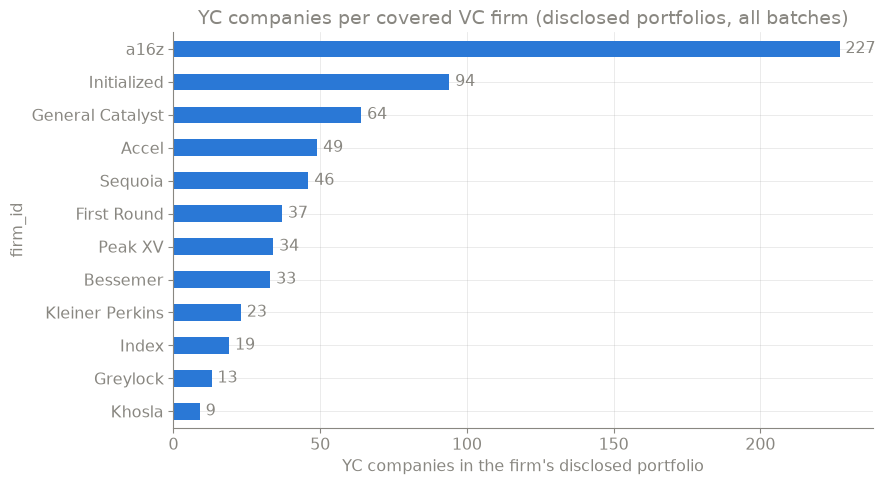
Andreessen Horowitz shows more than 220 YC companies on its portfolio page, well over twice as many as any other firm we tracked. Initialized is a distant second with over 90, followed by General Catalyst with over 60, and Accel and Sequoia with close to 50 each. More than 80 companies appear on two or more firms' lists. That overlap doesn't mean the firms invested together, only that each chose to list the company.
Historically, business software won and hardware lagged
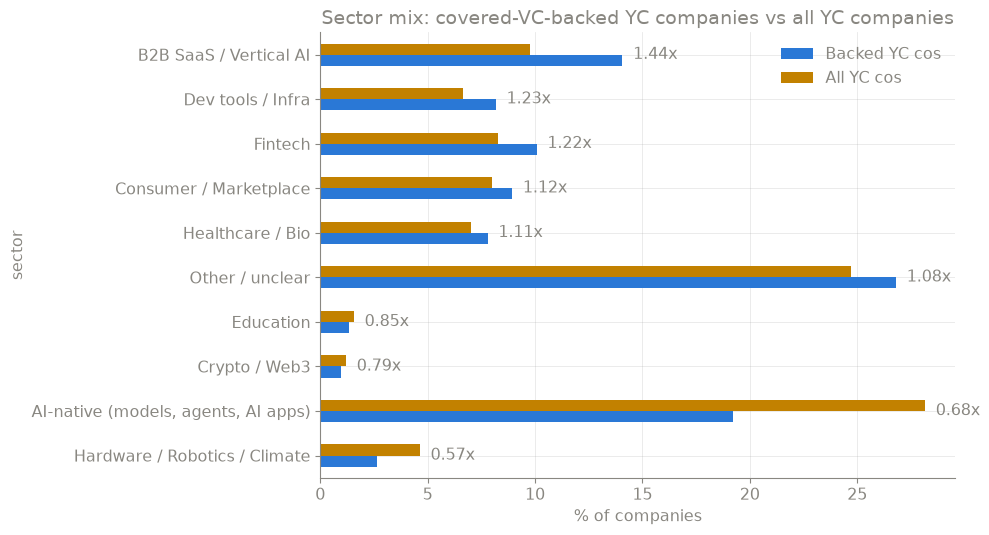
Compared with YC overall, these lists lean hard toward business software. B2B and vertical-AI companies make up about 14% of the listed group, against roughly 10% of YC, or about 1.4 times their share. Fintech and developer tools are also favored, at around 1.2 times. Hardware, robotics and climate sit at the other end, appearing at only about half their YC share.
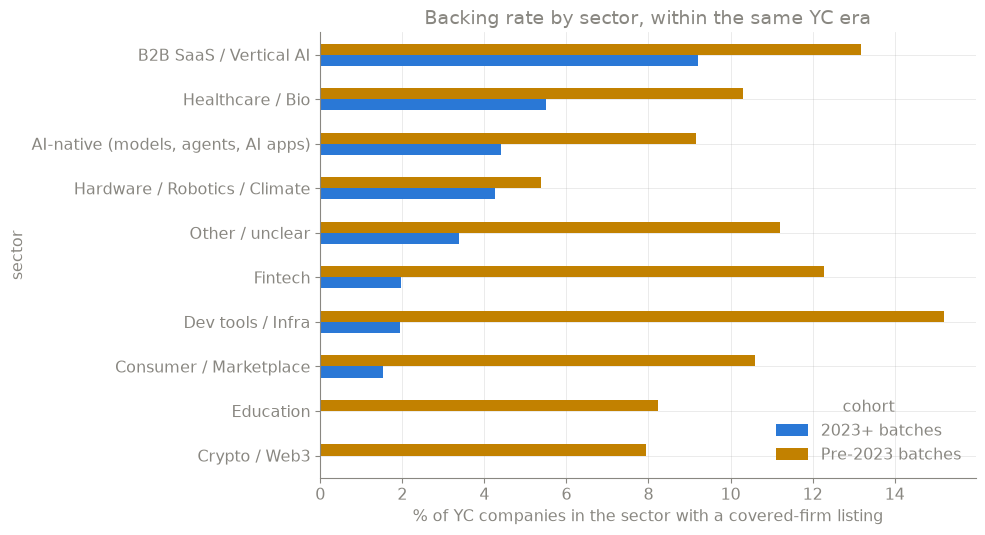
AI companies look under-represented at first glance, but that's mostly because they're so new. Within YC's batches from 2023 on, AI companies are listed at about the average rate for their year, roughly 4%. Business-software and vertical-AI companies from those same batches are listed about twice as often. Before 2023, developer tools had the highest listing rate, around 15%.
Every firm has its own taste
Individual firms tilt in their own directions. General Catalyst and Peak XV carry the largest share of AI companies. Accel leans toward developer tools and fintech, and Sequoia toward business software. These mixes reflect only what each firm publishes, so they describe each firm's public portfolio, not its full book.
The older the batch, the more likely the listing
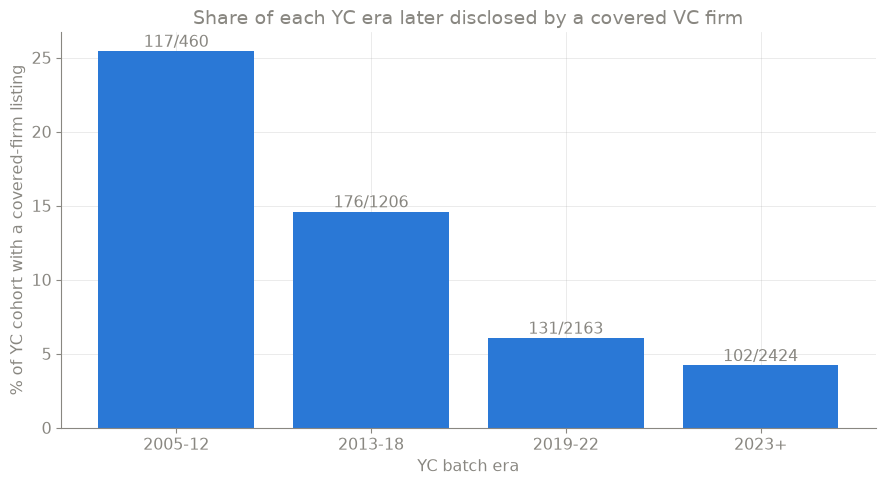
Time matters a great deal. About a quarter of YC companies from 2005 to 2012 appear on these lists, including Airbnb, Stripe, Dropbox, Instacart, Coinbase, Reddit and Zapier. That drops to about 15% for 2013 to 2018, about 6% for 2019 to 2022, and about 4% for 2023 onward. Older companies have had years to raise the later rounds these firms usually lead, so the recent batches are still catching up.
Listed companies fare better
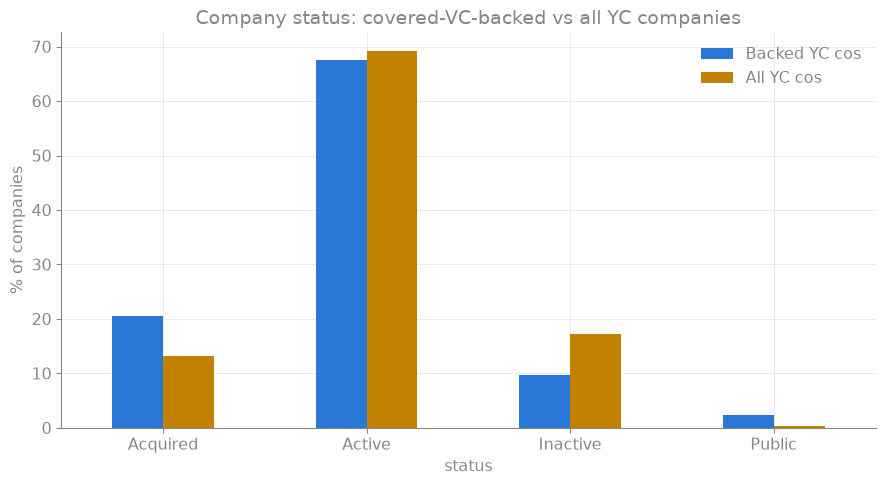
Listed companies are about five times as likely to be public as the typical YC company. Roughly 1 in 5 has been acquired, against about 1 in 8 across YC, and only around 1 in 10 is inactive, against nearly 1 in 6. Some of that is good picking. Some of it is what firms choose to show, since winners get listed more readily than companies that quietly wound down.
Following the money is harder than it looks
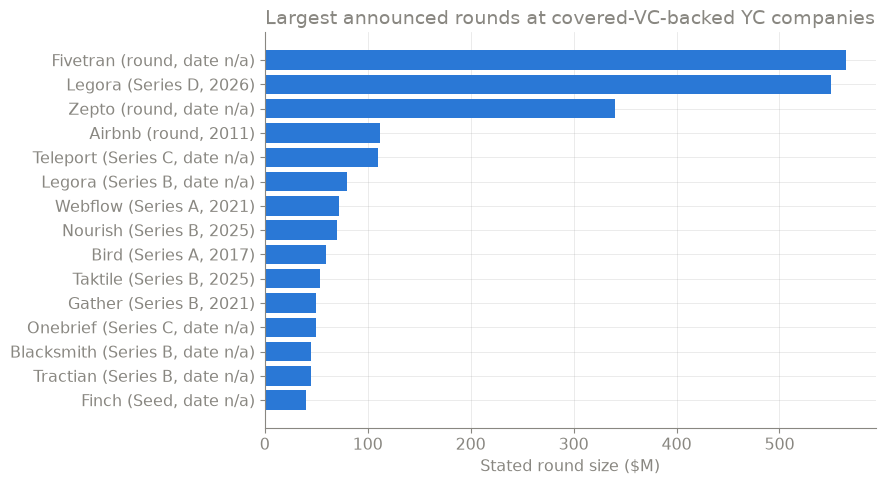
The public record on dollars is patchy. Firms' own funding announcements name investors, but only about a third of them state a round size. Where they do, the typical round is around $25 million. The largest are Fivetran at $565 million and Legora at $550 million, and those figures are round totals, not a single firm's check.
SEC filings fill in some of the gaps. Companies raising private money file a Form D, which reports how much was sold and when but never names the investors. We found more than 400 of these filings covering about 170 of the listed companies. The biggest is Airbnb's 2015 filing, at $1.5 billion.
What's changing: hardware is back in the conversation
The hardware gap in these portfolio lists may not last. Across the wider market, investors are putting record sums into robotics and other physical-world companies. By mid-June, robotics startups worldwide had raised $18.8 billion in 2026. That's more than the $15 billion raised in all of 2025, and more than the $14.1 billion raised in 2021, the previous peak year for venture funding.
Much of that money is going out in very large rounds. Skild AI raised $1.4 billion, tripling its valuation to about $14 billion in roughly seven months. Saronic raised a $1.75 billion Series D. Apptronik added $520 million to its Series A, bringing the round to more than $935 million. Some of the firms in our set are part of the shift: Accel and a16z were among the backers of Mind Robotics' $500 million Series A. Mind Robotics, a Rivian spinout, raised another $400 million in May, taking its total past $1 billion.
Behind the surge is a change in how investors see the category. For years, robotics was treated as a capital-hungry hardware bet with slow timelines. Many investors now see it as the next stage of AI, with robots as a way to put AI models to work in the physical world.
The bottom line
Out of more than 6,000 YC companies, a little over 500 have made it onto these 12 firms' public pages. They are mostly business-software companies from YC's earlier years, they have outperformed the rest of YC, and a16z shows more of them than anyone else. But a portfolio page is a highlight reel, not a full record. Deals firms don't mention, amounts they leave out and investors that filings never name all mean the real picture is bigger than any list can show. With record money now flowing into robotics and hardware, the next version of these lists may look quite different.
Sigmo can make mistakes — verify important info. Not financial advice.
Get AlphaWeekly in your inbox
Free. New issues as they are published, with the charts and the method in view.