
MSTR’s Bitcoin premium has flipped — and that changes the trade
For years, Strategy (MSTR) was treated as a turbocharged way to own Bitcoin. The company could sell expensive stock or convertible debt, buy more Bitcoin, and increase the amount of Bitcoin backing each share.
That engine looks very different today. At roughly $154 per share, MSTR’s equity is worth about $47.3 billion against roughly $53.4 billion of Bitcoin. On a simple basis, the stock trades at about 0.89x Bitcoin NAV — below the value of the coins it owns.
But that does not automatically make MSTR cheap. Debt and preferred securities sit ahead of common shareholders. After accounting for those claims, the common stock is closer to 1.41x net NAV.
The key finding: MSTR is now a two-part bet — where Bitcoin goes, and whether investors are willing to pay a premium for the MSTR wrapper again.
Figure 1
The financing machine worked — when the stock traded at a premium
Management did create real value on a per-share basis. Bitcoin per share increased about 443%, while the share count rose about 218%. Dilution did not simply erase the Bitcoin accumulation.
The catch is that the strategy worked best when MSTR itself was expensive. In quarters when the stock traded above 2x NAV, median Bitcoin-per-share growth was about +41%. When MSTR traded below 1.0x NAV, growth was roughly flat at −0.1%.
Why? When MSTR trades far above the value of its Bitcoin, it can issue high-priced shares and use the proceeds to buy more Bitcoin. Below NAV, issuing common stock becomes much less attractive because it can dilute existing holders.
So the old engine is not gone — but its most powerful gear is currently off.
That premium compression already shows up in performance
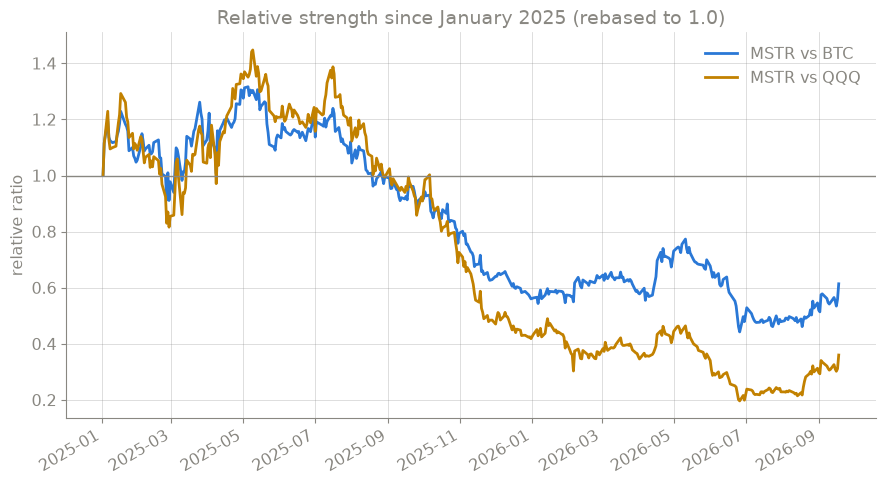
Since January 2025, the MSTR/BTC ratio is down about 39%. In other words, holding Bitcoin directly would have outperformed MSTR over this period even though MSTR still owns the same underlying asset.
The difference is mostly valuation: investors stopped paying the extreme premium they once paid for MSTR’s financing and Bitcoin-accumulation model.
Figure 7
Financing still matters
MSTR has also benefited from issuing convertible bonds — debt that becomes more attractive to buyers when the stock’s volatility is high. Today, implied volatility is about 76% versus roughly 100% realised volatility over the last month.
That does not mean financing is closed, but it suggests one of MSTR’s cheapest capital-raising channels is less powerful than it was during the most speculative periods.
Meanwhile, debt and preferred securities total about $19.8 billion, or roughly 37% of the current Bitcoin treasury value. Those claims amplify the common stock in both directions: Bitcoin upside can produce larger percentage gains for equity holders, while a large Bitcoin decline can compress the value left for common shareholders much faster.
The scenario that matters most
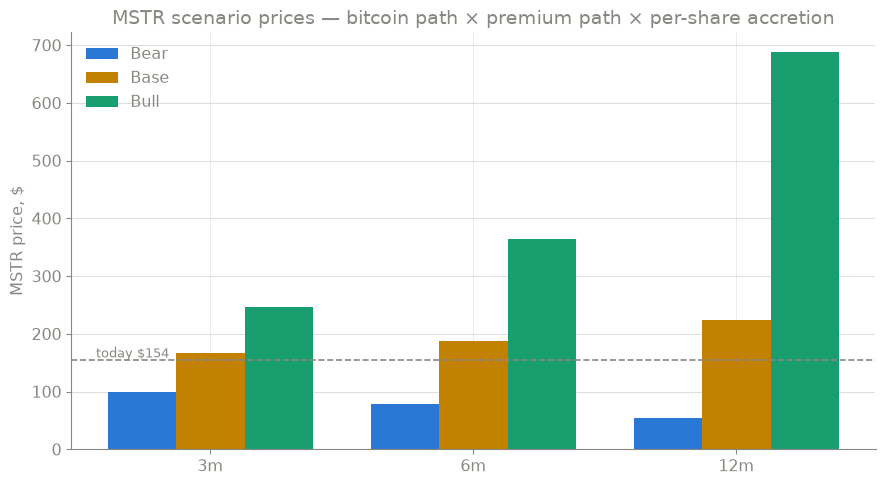
This is where the MSTR story becomes clear. If Bitcoin rises 120% but MSTR stays near today’s 0.89x NAV, the model puts the stock around $339. If Bitcoin makes the same move and MSTR’s premium expands back to 1.45x NAV, the stock reaches roughly $688.
On the other side, the 12-month bear scenario falls to about $54 as both Bitcoin and the premium decline.
That is the central risk: getting Bitcoin right is not enough. MSTR investors are also making a separate bet on the market eventually paying more for the corporate wrapper.
Figure 10
What would change the story?
Watch three things: Bitcoin itself, MSTR’s NAV premium, and the cost of raising new capital. A rising premium would reopen the company’s ability to issue expensive equity and potentially grow Bitcoin per share faster again. Stronger demand for MSTR convertibles would help for the same reason.
Short interest is about 10.4% with cheap borrow and only 2.0 days to cover, so the current setup does not look like a classic short squeeze. A sustained move higher would more likely need real demand — not forced covering.
Final takeaway
MSTR still offers leveraged exposure to Bitcoin, but the reason it can dramatically outperform Bitcoin is not leverage alone. Historically, the biggest upside came when Bitcoin rose, MSTR’s premium expanded, and that premium allowed the company to raise capital efficiently and buy still more Bitcoin.
Today, the premium is compressed. That makes the setup more complicated: Bitcoin can rise while MSTR still underperforms if the wrapper remains out of favor.
The question is no longer just “Where does Bitcoin go?” It is “What will investors pay for MSTR on top of the Bitcoin it owns?”
Sigmo can make mistakes — verify important info. Not financial advice.
Get AlphaWeekly in your inbox
Free. New issues as they are published, with the charts and the method in view.