
Palantir’s Business Improved Dramatically. Its Valuation Leaves Little Room for Error.
Revenue growth, expanding margins and commercial acceleration support PLTR’s re-rating — but at roughly 73x sales, future returns depend heavily on sustaining exceptional growth.
Five years, three very different regimes
Methodology: We reviewed Palantir’s last five years across price, revenue, margins, earnings, government awards and ownership. We then modeled three-year outcomes using transparent assumptions for revenue growth, share count and valuation multiples.
Figure 1
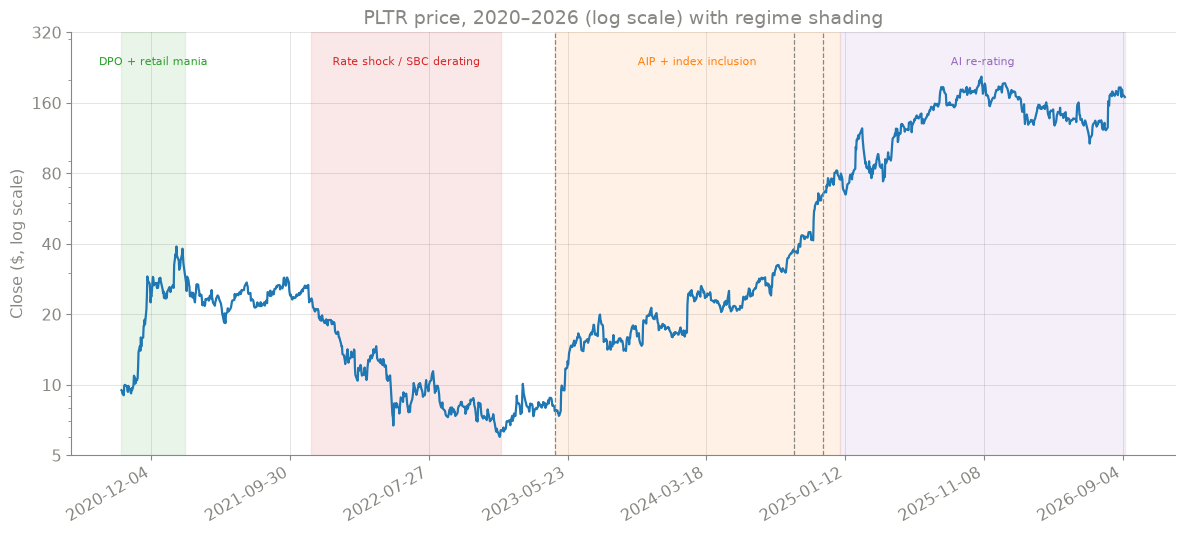
PLTR has moved through three distinct market regimes. The stock peaked near $39 during the 2021 retail-driven run, collapsed toward $6 in 2022, then entered a powerful re-rating beginning around April 2023 and accelerating through its 2024 index inclusions.
Revenue continued growing throughout the period, but the magnitude of the stock move cannot be explained by revenue growth alone. Valuation expansion has been a major driver of returns.
Figure 2
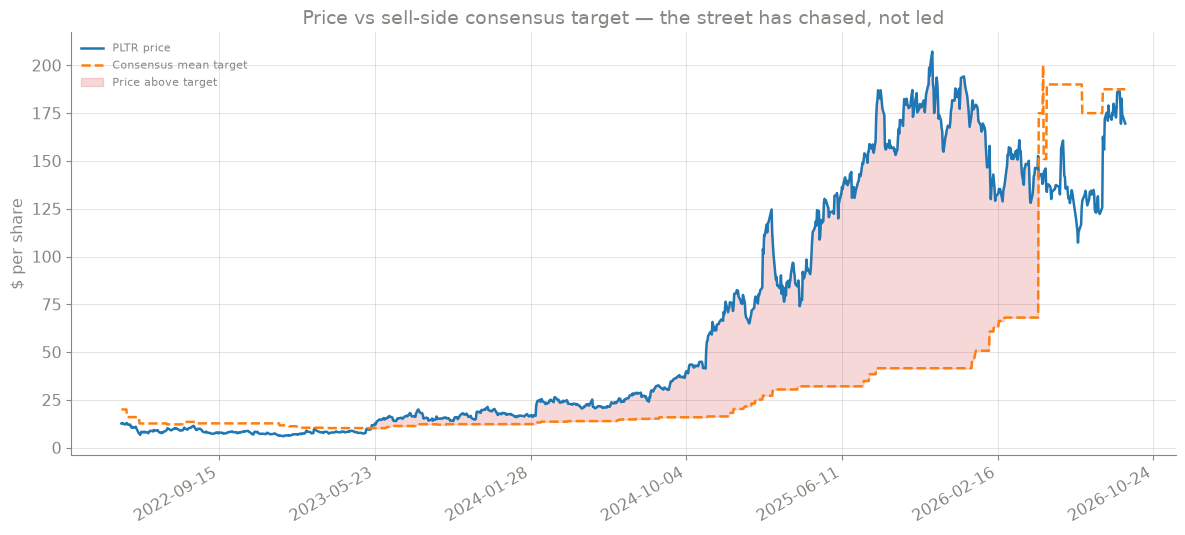
Wall Street sees limited upside from the reference price. Consensus stands near $188 versus roughly $170 in the analysis, implying about 11% upside. Analyst targets can lag fast-moving stocks, so the more important signal is that professional expectations remain considerably more restrained than PLTR’s recent market momentum.
PLTR’s biggest stock moves have also been multiple moves. Revenue rose consistently, but the strongest and weakest periods for the stock coincided with major changes in what investors were willing to pay for that growth. That makes valuation almost as important as operating performance when thinking about future returns.
The fundamental improvement is real
Margins help explain why the market re-rated the business. Gross margin reached roughly 85%, while GAAP profitability improved dramatically from deeply negative levels and trailing free-cash-flow margins expanded substantially. The combination of revenue growth and operating leverage marks a major change from the Palantir investors owned several years ago.
Figure 3
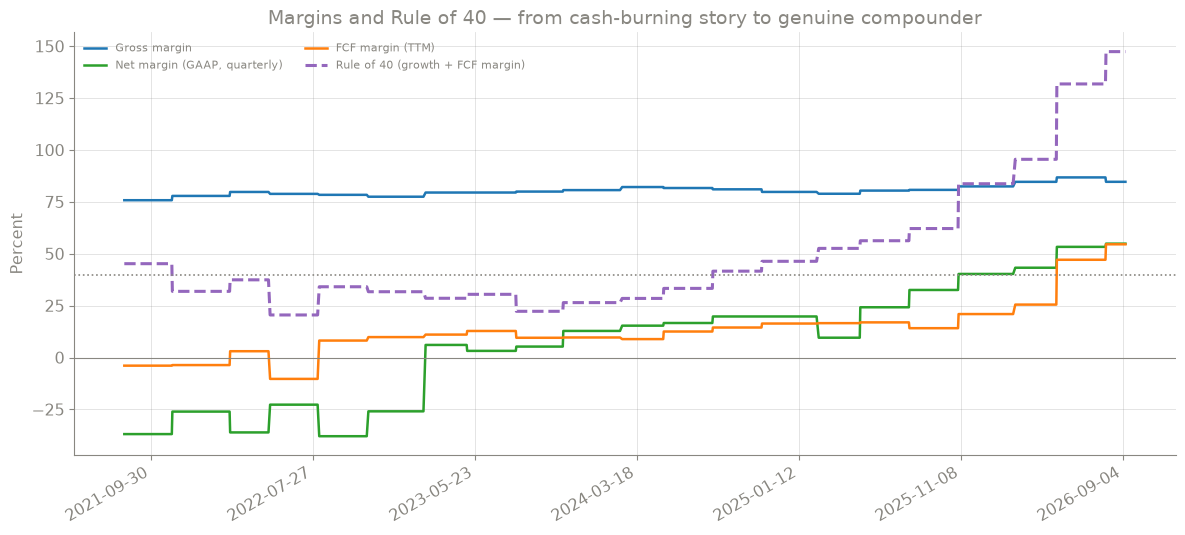
Figure 4
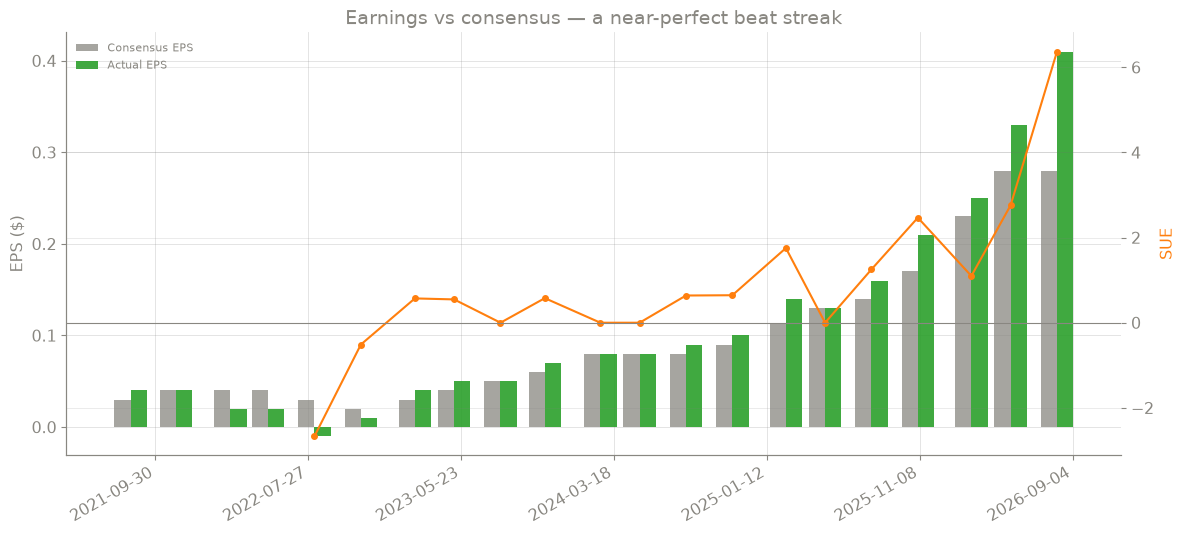
Earnings execution has also been consistent. Palantir beat EPS expectations in 17 of 21 quarters in the sample, with an average surprise of roughly $0.012. The median next-day stock move following earnings was about 1.4%, although individual reactions ranged from roughly -11% to +9%.
Government moat, commercial acceleration
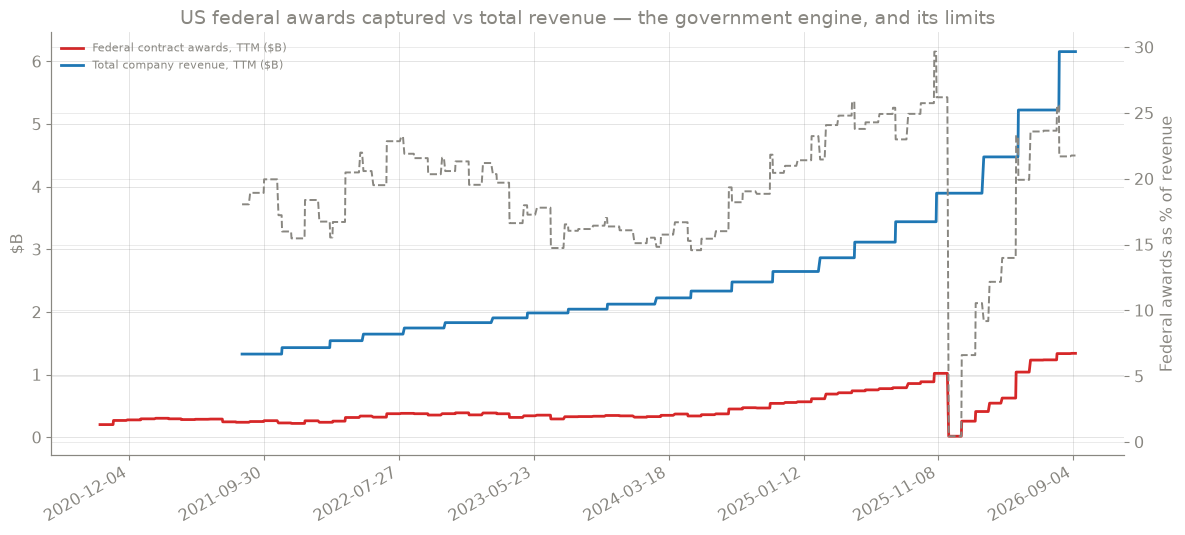
Government relationships remain a core competitive advantage, while commercial adoption adds a second growth engine. Trailing federal awards in the dataset increased from roughly $0.20B to $1.34B. These figures represent notional new awards rather than recognized revenue and may exclude classified work, so the trend is more informative than the absolute dollar amount.
Figure 5
Growth is separating Palantir from the comparison group
Figure 6
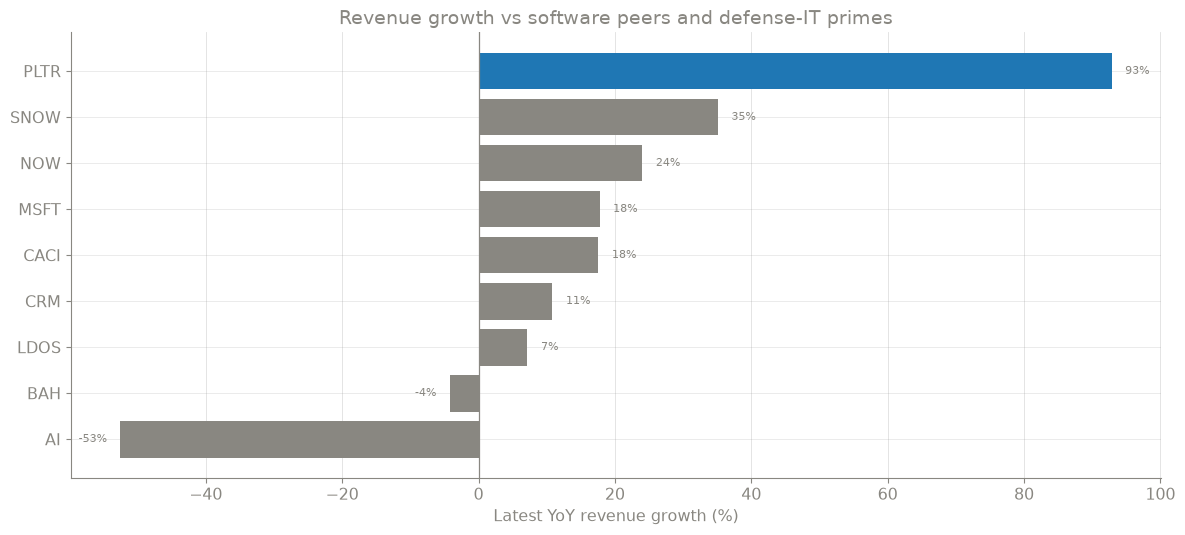
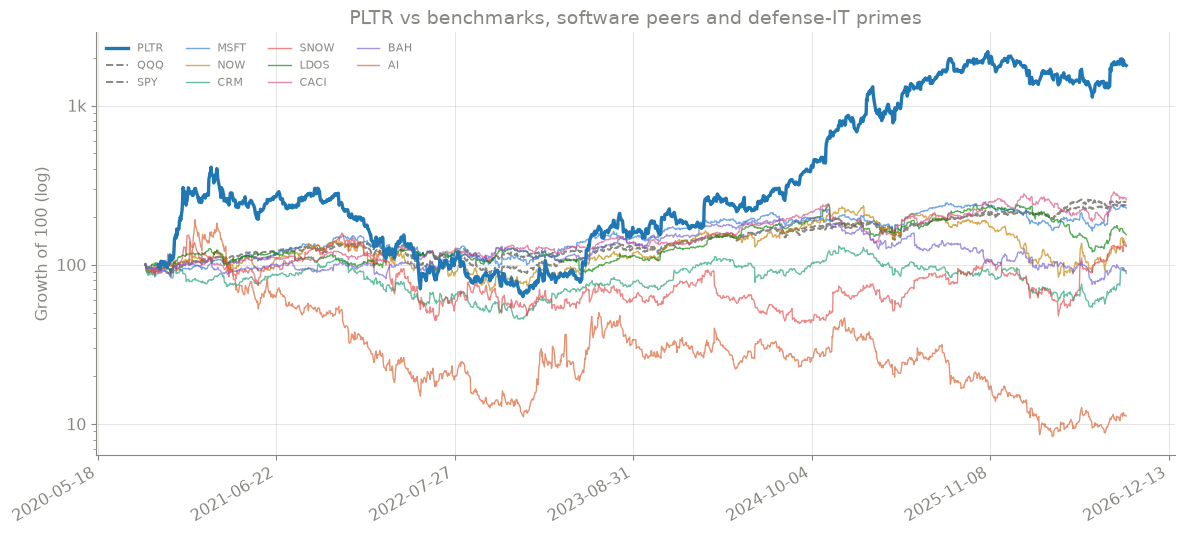
Palantir’s growth stands well above the comparison group. The analysis shows PLTR growing roughly 93% on the metric represented above, while traditional defense IT peers were growing much more slowly or contracting. That differential helps explain why PLTR commands a dramatically higher valuation.
The problem is how much growth is already priced in
At roughly 73x sales in this analysis, PLTR is priced for exceptional future execution. The company does not merely need to grow — it needs to sustain unusually high growth while preserving strong margins for years.
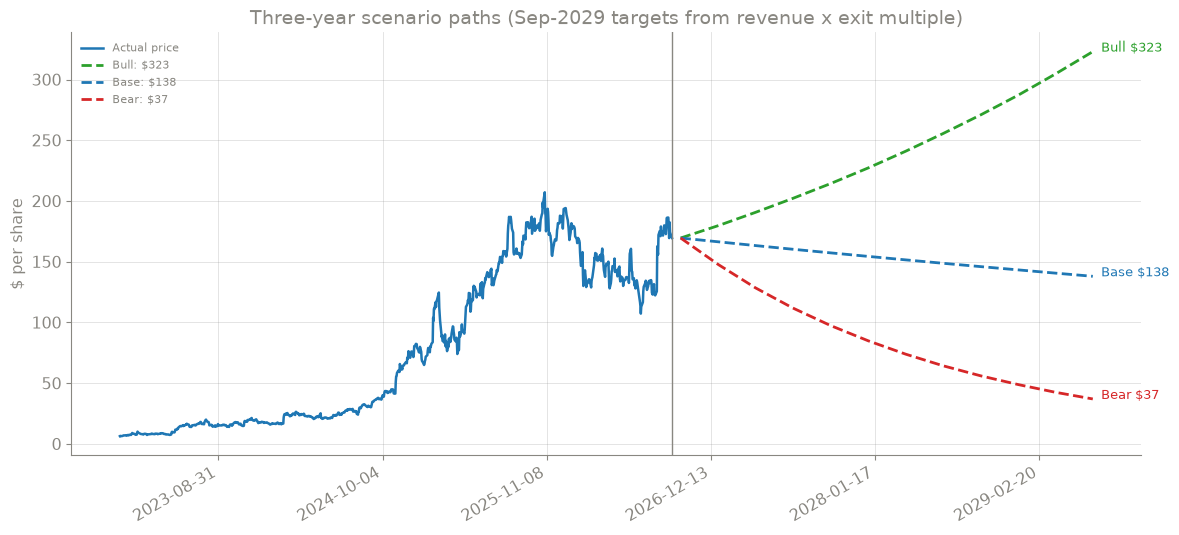
The scenario analysis makes that hurdle clearer: generating roughly a 12% annualized return through September 2029 under the model requires revenue approaching $25B, equivalent to roughly a 60% compound annual growth rate from the model’s starting point.
Figure 7
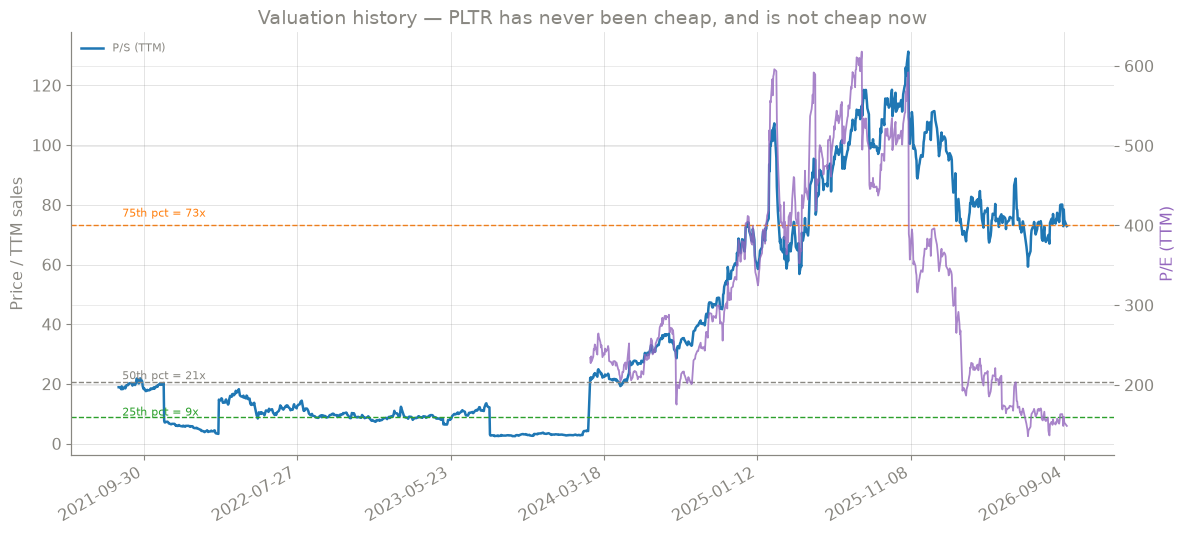
Valuation is the central risk. Even if Palantir continues growing earnings and revenue, future shareholder returns can disappoint if the valuation multiple investors are willing to pay contracts substantially.
Figure 8
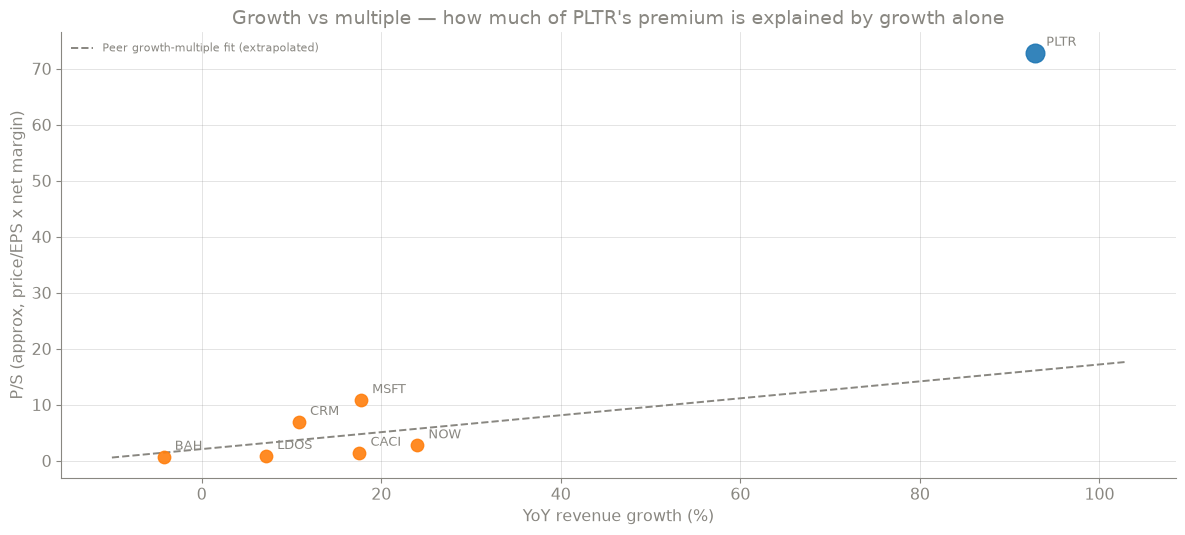
The premium is partly supported by exceptional growth — but the valuation raises the execution bar. Continued revenue acceleration and margin expansion could support a premium multiple. Slower growth, however, creates the risk of weaker fundamentals and multiple compression occurring at the same time.
Ownership and positioning
Figure 9
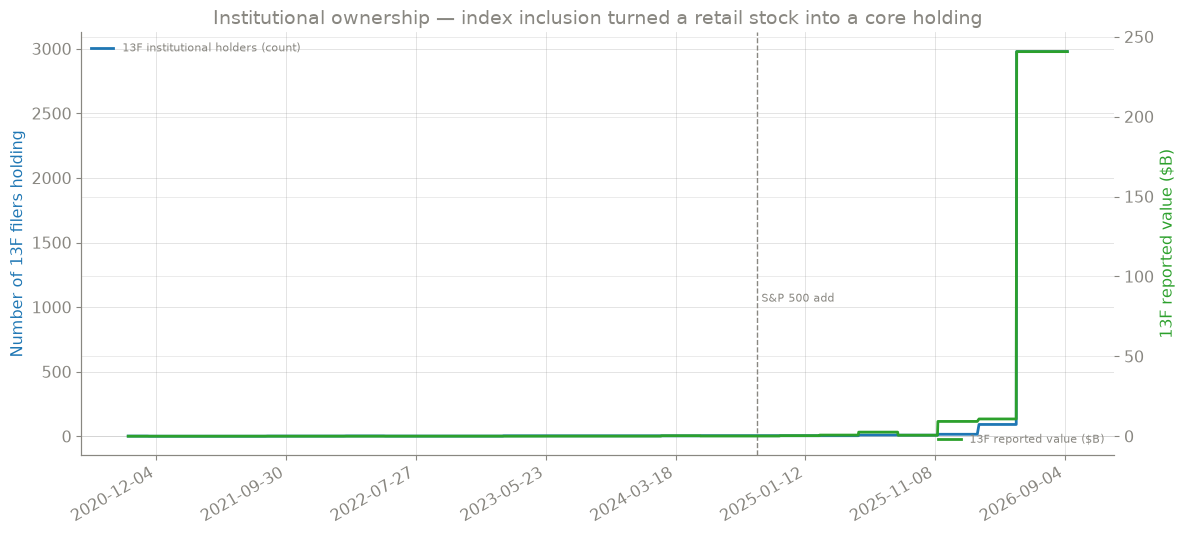
Institutional participation increased materially following index inclusion. The dataset shows institutional holders rising to 2,978. Index membership can create structural demand from passive and benchmark-aware investors, although those flows should not be confused with fundamental conviction.
Short interest stands near 68M shares with roughly 1.1 days to cover, while insiders were net sellers of approximately $70M over the prior 90 days in the dataset. Insider selling is worth monitoring, but by itself does not establish a bearish fundamental signal.
Figure 10
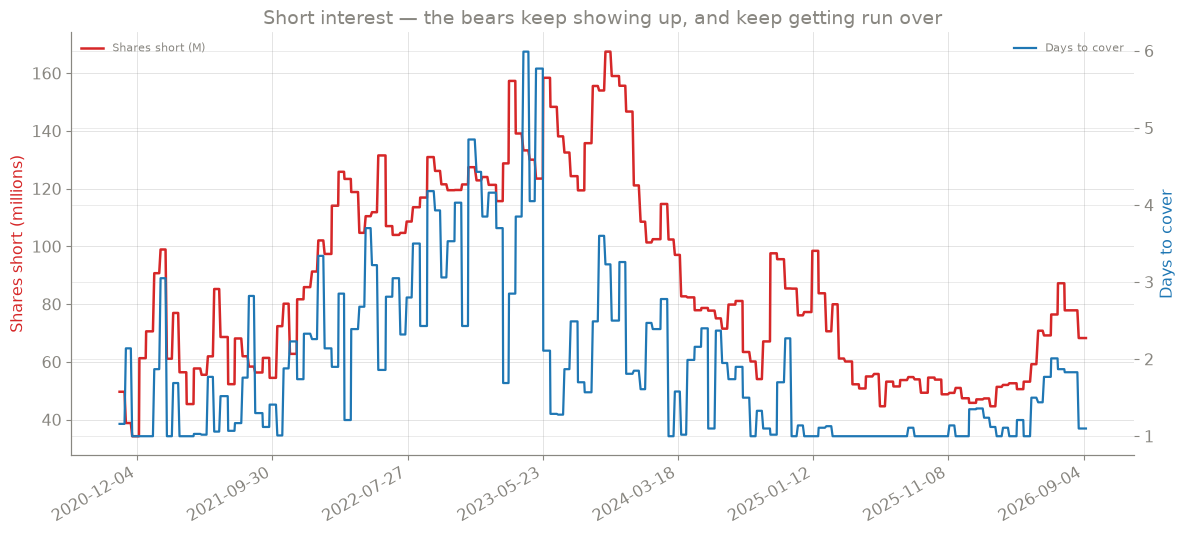
Figure 11
Where PLTR could go: bull, base and bear
These are scenario models, not price forecasts. Under the assumptions used in the analysis, the September 2029 outcomes are:
- Bull: $323
- Base: $138
- Bear: $37
The unusually wide range reflects PLTR’s valuation sensitivity. Changes in long-term growth expectations or the exit multiple can produce dramatically different outcomes.
The takeaway: Palantir’s fundamental improvement is real — growth has accelerated, margins have expanded and the business has strengthened across government and commercial markets. The debate is no longer simply whether Palantir is a strong business. It is how much of that strength is already reflected in the price.
At a valuation near 73x sales in this analysis, strong execution alone may not be enough. To generate attractive long-term returns from this starting point, Palantir needs to sustain exceptional growth while avoiding substantial multiple compression.
Figure 12
Sigmo can make mistakes — verify important info. Not financial advice.
Get AlphaWeekly in your inbox
Free. New issues as they are published, with the charts and the method in view.