
What History Suggests for Tomorrow’s Fed Hike
The hike itself may not be the real catalyst. History says guidance and long-term Treasury yields matter more.
The quick take
History points to a small initial move, a possible short-lived bounce, and a much bigger focus on what happens to yields afterward.
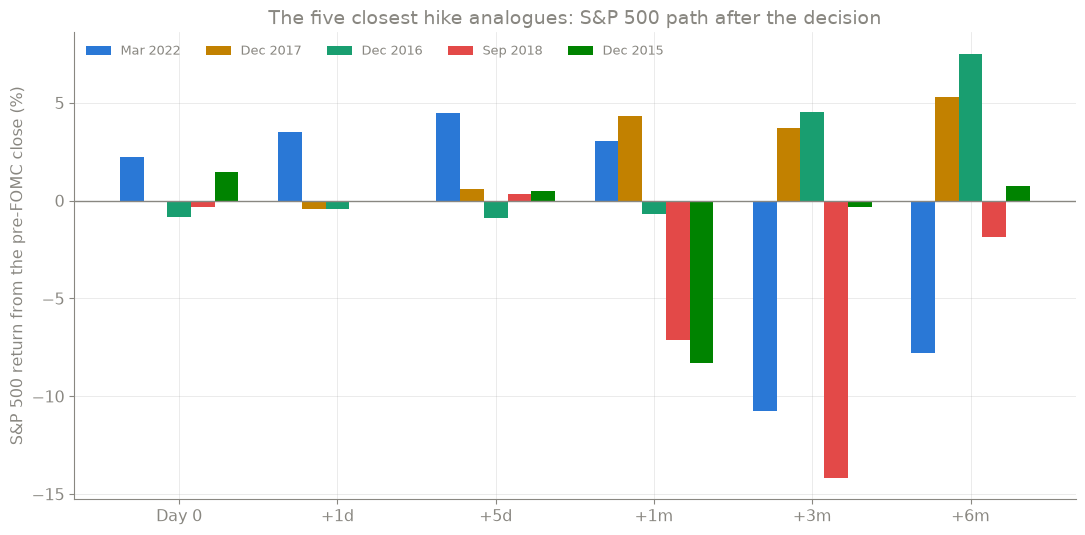
The five closest historical setups — March 2022, December 2017, December 2016, September 2018 and December 2015 — were all hikes that markets largely expected beforehand.
The median S&P 500 move on decision day was essentially flat at -0.01%. Markets then tended to drift modestly higher over the following week before giving much of that move back within a month.
Being priced in did not guarantee a rally. It mainly reduced the size of the reaction: 62% of Fed hike days since 2005 finished within ±1%.
Figure 1
What happened after similar hikes?
Announcement day was close to a coin flip. Across the five closest analogues, the median return was -0.01% and the average was +0.51%.
That average is heavily influenced by the +2.22% March 2022 rally. Five sessions after the decision, the median return improved to +0.48%.
After that, outcomes became much less predictable. One-month returns ranged from roughly -8.3% to +4.4%, while the average three-month return was -3.4%.
The Fed decision itself told investors far less than what happened to inflation, growth and yields afterward.
Figure 2
The typical pattern: bounce, then fade
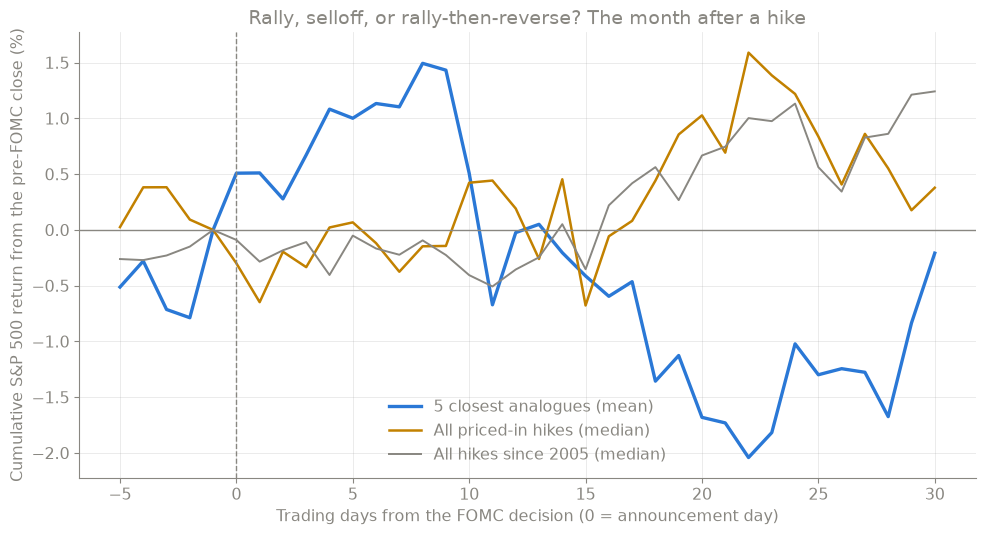
The average path of the closest historical analogues shows a familiar pattern.
Stocks drifted up to about +1.5% by day 8, then gradually gave those gains back. By the end of the first month, the average return had fallen to roughly -0.2%.
That means the most common historical setup was not a major breakout or immediate crash. It was a small relief move followed by a reassessment over the next several weeks.
Figure 3
What matters more than the hike
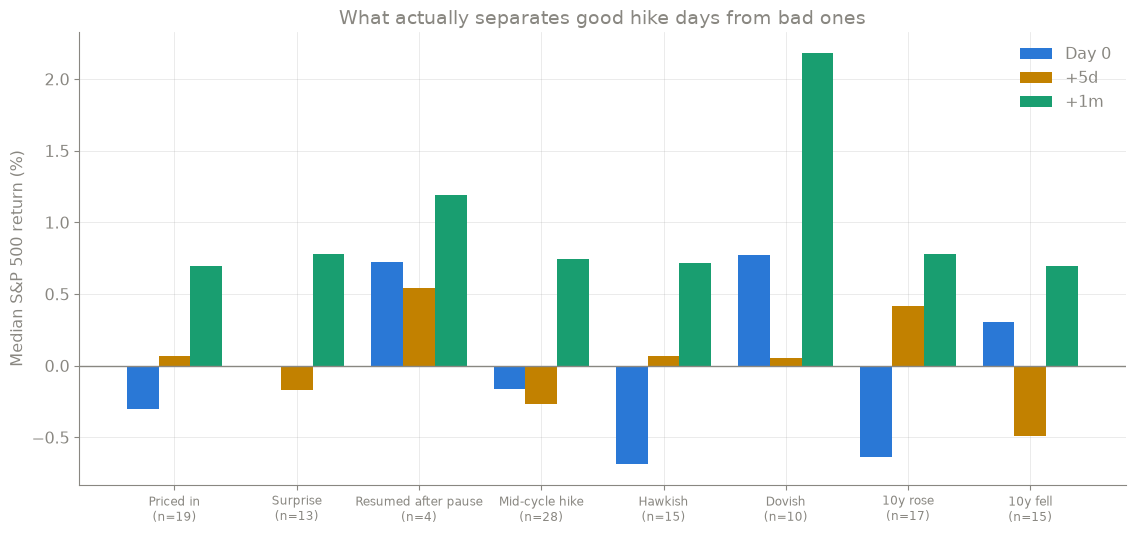
The strongest historical signal was not whether the hike was expected. It was how bond yields reacted to the Fed's message.
When the 2-year Treasury yield fell after the decision — a sign that investors interpreted the Fed as relatively dovish — the S&P 500 finished higher 60% of the time and gained about 2.2% over the following month.
When the 2-year yield rose on a hawkish message, the market was green only 27% of the time.
The same pattern appeared in the 10-year Treasury. When the 10-year yield declined after the meeting, stocks performed considerably better. When long-term yields continued climbing, equities struggled.
This matters because the 10-year is already near 4.8% after rising for several months, while inflation has moved back toward 3.4%.
Tomorrow's key question is therefore not simply “Did the Fed hike?” It is “Does the market believe more tightening is coming?”
Figure 4
Three scenarios for tomorrow
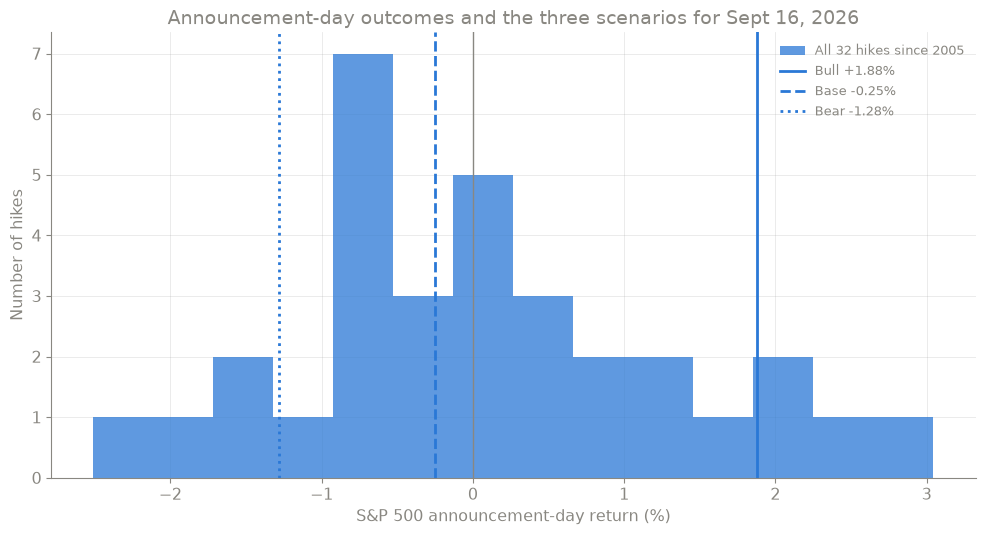
Base case: A mostly expected hike with neutral guidance. History suggests a relatively small reaction — around -0.25% on the day — followed by modestly positive performance over the next month.
Bull case: The Fed presents the move as largely one-off, future hikes look less likely, and the 10-year yield falls. Comparable cases point to roughly +1.9% on the day and +3.9% over one month.
Bear case: The Fed signals additional tightening and long-term yields continue higher. Historical comparisons imply roughly -1.3% on decision day and around -4.5% over the following month.
Nasdaq could amplify the move
The Nasdaq-100 historically behaved like a higher-beta version of the S&P around these events.
Its median announcement-day return was -0.11%, while the one-month median was +1.83%.
That suggests growth and technology stocks could outperform if yields fall after the meeting — but they also remain more vulnerable if long-term rates continue climbing.
The Nasdaq sample is smaller, covering 20 of the 32 Fed hikes studied.
Bottom line
History does not suggest that an expected Fed hike automatically sends stocks lower — or higher.
The more common pattern is a muted decision-day reaction, sometimes followed by a brief relief rally, before markets refocus on inflation, growth and Treasury yields.
For tomorrow, watch three things:
- The Fed's guidance: Is this presented as a one-off move or the beginning of more tightening?
- The 2-year Treasury: A quick read on whether markets interpret the message as hawkish or dovish.
- The 10-year Treasury: Falling yields would support equities; another move higher would increase pressure on valuations, especially technology stocks.
The hike is largely known. The reaction to what comes next is what matters.
Historical comparisons are based on small samples and should be treated as context rather than prediction.
Sigmo can make mistakes — verify important info. Not financial advice.
Get AlphaWeekly in your inbox
Free. New issues as they are published, with the charts and the method in view.