
Rocket Lab: Great Company, Difficult Valuation ?
Electron proves Rocket Lab can execute. Neutron has to prove it can scale — and at $62.55 as of September 15, 2026, the stock already assumes a lot goes right.
The core finding: Rocket Lab's business is improving quickly. Revenue is growing, margins are expanding, the balance sheet is strong, and it is the clear #2 Western launch operator. The harder question is whether today's valuation already prices in too much of that future.
1. The investment case in one minute
Revenue has grown from $436M to $602M, with roughly $966M estimated for FY2026. Gross margin has improved by about ten points in two years, while Rocket Lab holds roughly $2.13B of cash and almost no debt.
But the stock is priced for much more.
At roughly 44x trailing sales, RKLB needs about $5.7B of 2030 revenue at a 10x exit multiple just to generate a 12% annual return from the $62.55 September 15, 2026 share price. That is above even this model's Bull case.
- Electron proves execution, but it is too small. Even 50 launches a year produce only about $416M of revenue.
- Neutron is the key. Reuse, cadence and launch economics determine whether Rocket Lab can grow into today's valuation.
- Space Systems matters. Sustained 30%+ growth significantly improves the long-term case.
- Valuation itself is a major risk. Future returns depend partly on RKLB keeping a premium multiple.
Figure 1
2. Price, growth and Electron
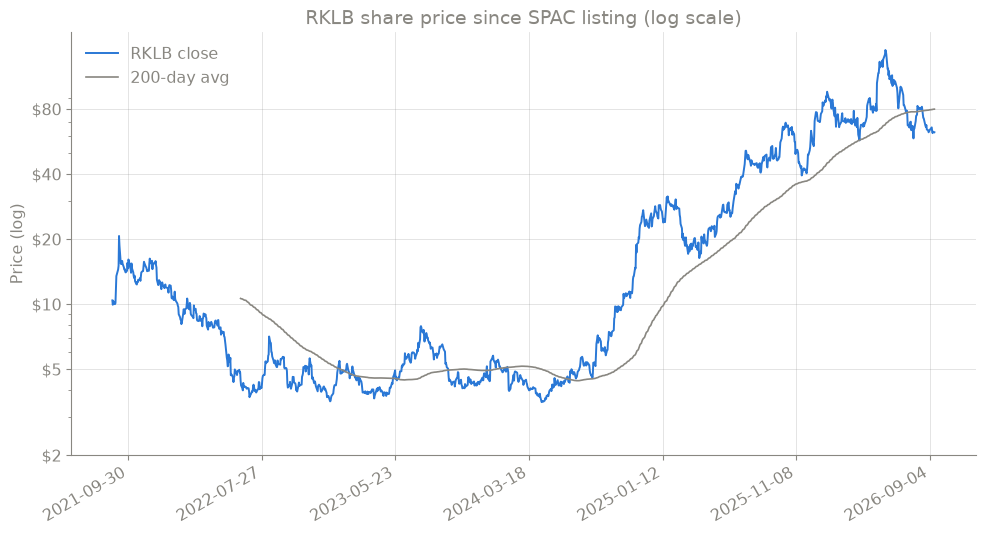
RKLB traded around $62.55 on September 15, 2026. That is roughly 18x its April 2024 low, although still about 58% below its May 2026 high.
Rocket Lab remains a future-growth story. It has not yet posted a profitable quarter, so today's valuation depends heavily on Neutron and Space Systems scaling successfully.
Figure 3
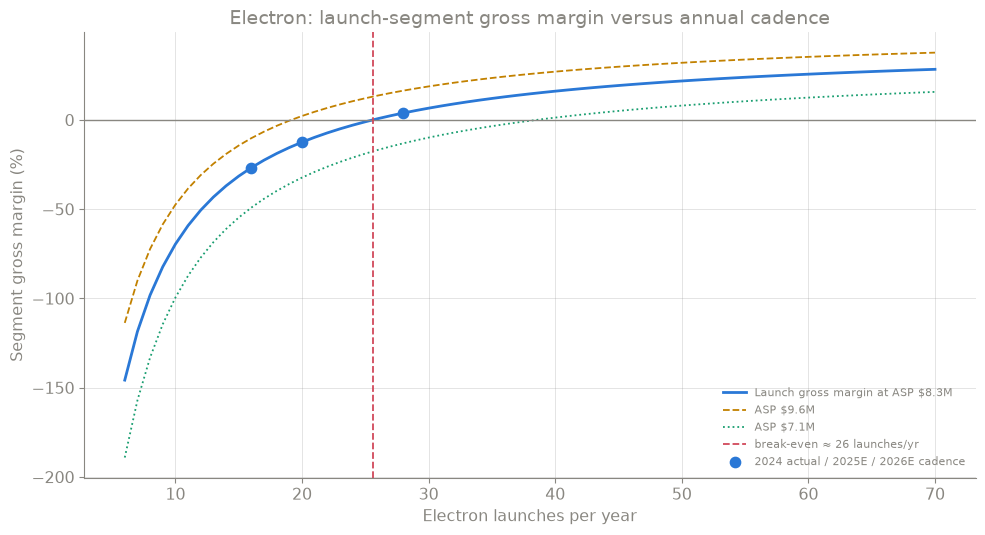
Electron is a strong business, but its size is limited. FY2024 Launch revenue implies an average selling price near $8.3M per launch.
Using the model's cost assumptions, break-even comes around 26 launches per year. But even 50 launches generate only about $416M of annual revenue.
Electron can be highly successful without being large enough to justify RKLB's valuation by itself.
3. Neutron — the valuation hinge
Figure 4
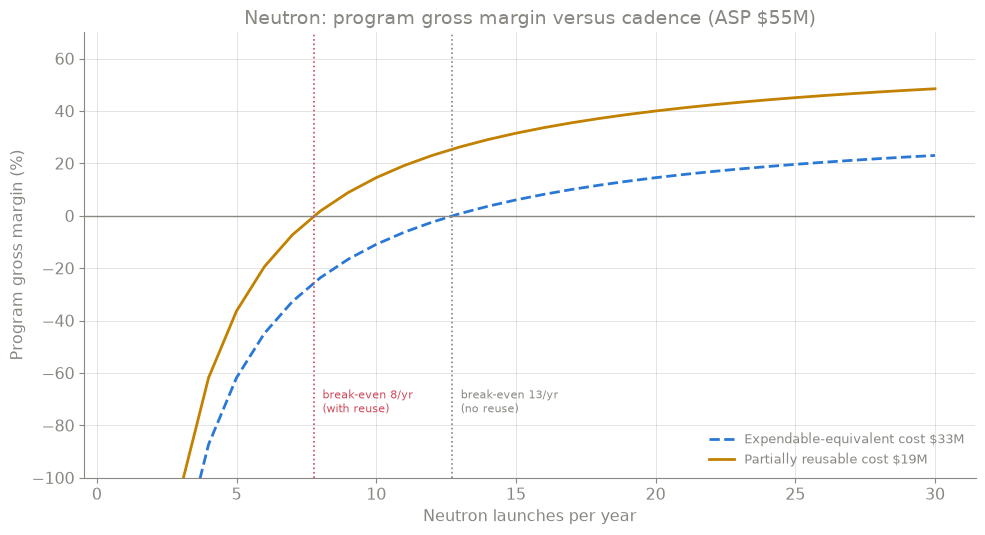
Neutron is the biggest piece of the valuation story.
At an assumed $55M per launch, the model needs roughly 8 annual flights with successful booster reuse to break even, versus about 13 without reuse.
At 20 launches a year, Neutron could generate about $1.1B of revenue. That would transform Rocket Lab's scale.
The risk is timing: every delay pushes those revenues further into the future.
4. Competition — cost and cadence
Figure 5
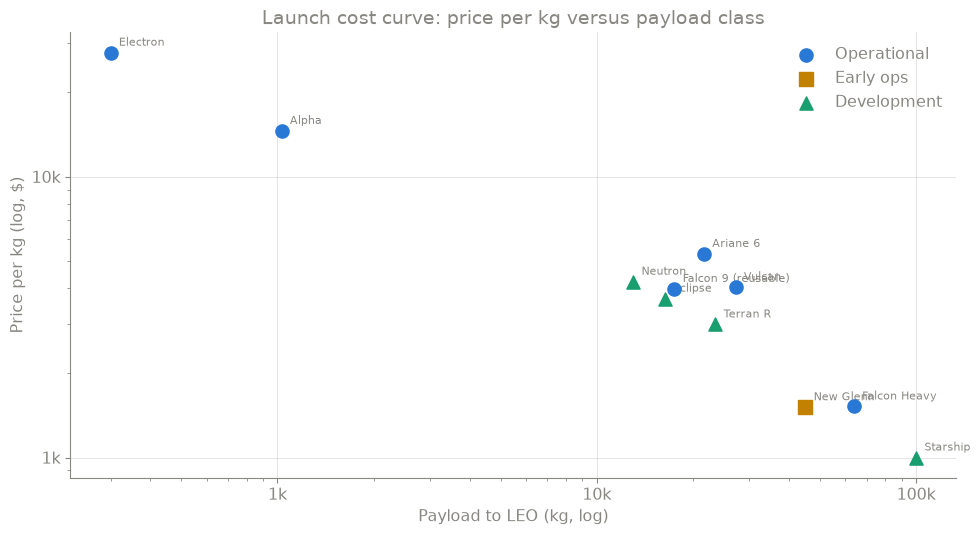
Electron competes on flexibility, not price. Its modeled cost is roughly $27,667/kg, compared with about $3,986/kg for Falcon 9.
Customers pay the premium for dedicated launch timing and precise orbit insertion.
Neutron could land near Falcon 9 economics at roughly $4,231/kg. That would make it a credible second option, but not necessarily cheaper than SpaceX.
Figure 6
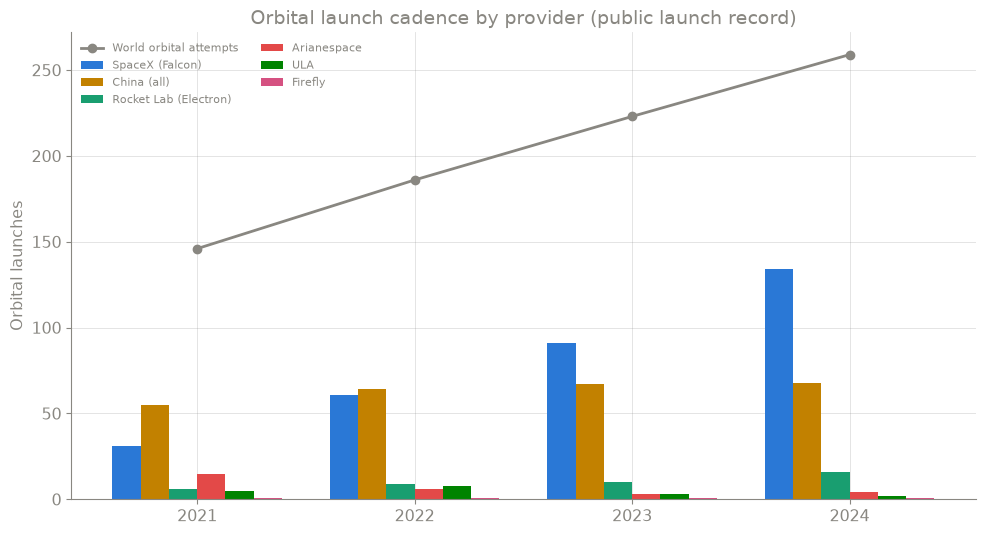
Rocket Lab has already proved launch cadence. It flew 16 Electron missions in 2024, making it the clear #2 Western launch operator.
SpaceX, however, flew 134 Falcon missions. Rocket Lab has a real position in the market, but the gap with the leader remains enormous.
5. Backlog and valuation
Figure 7
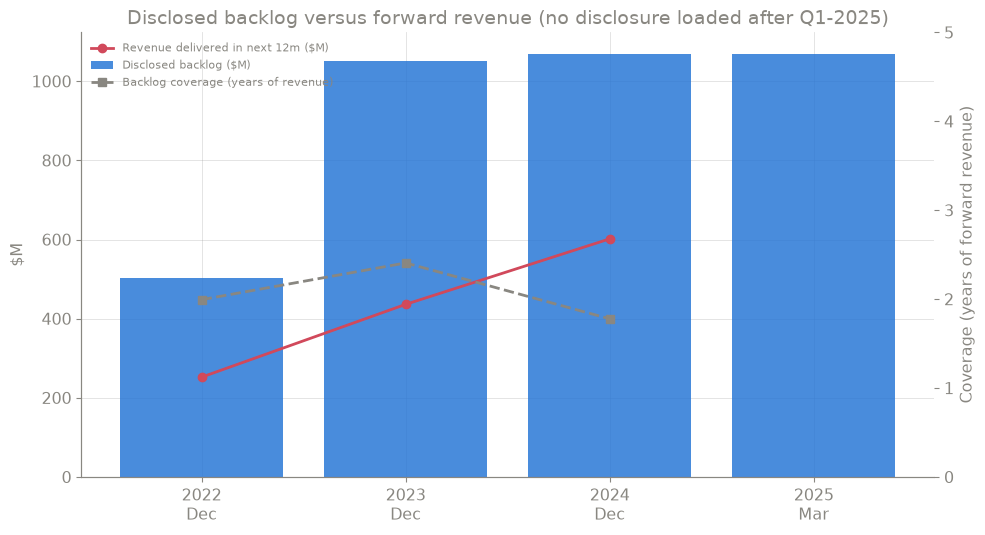
Backlog growth has slowed. It rose from $503M to $1.05B, then increased only about 2% to $1.07B while revenue grew much faster.
Backlog coverage fell from roughly 2.4 years of revenue to 1.8 years. That does not necessarily mean demand is weakening, but backlog provides less forward visibility than it did before.
Figure 8
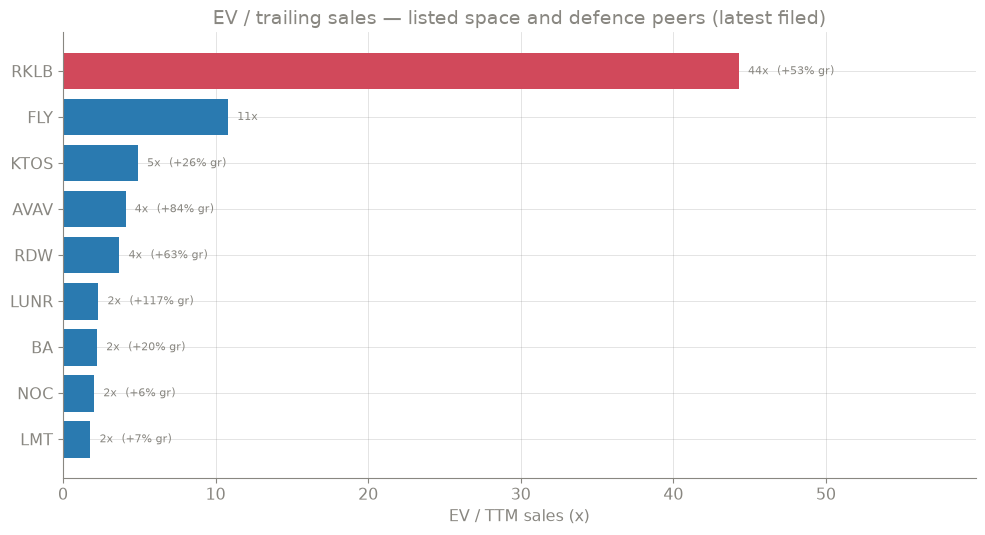
RKLB's valuation stands out. It trades near 44x trailing sales versus roughly 3x for the peer median.
SpaceX's reported December 2024 private valuation implied roughly 27x sales using estimated revenue. Those figures are press estimates, but the comparison still shows how much future growth RKLB already carries in its valuation.
6. Three paths to 2030
The model starts from roughly $966M of FY2026E revenue and builds Bear, Base and Bull scenarios.
Figure 9
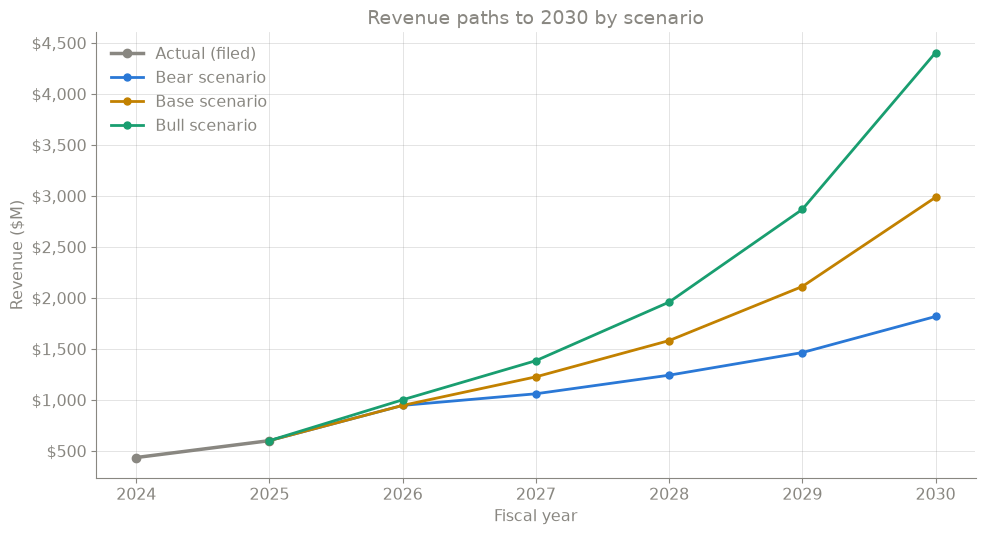
2030 revenue reaches $1.82B in Bear, $2.99B in Base and $4.41B in Bull. That equals annual growth of roughly 17%, 33% and 46%.
The Bull case already assumes strong execution: rapid Neutron scaling, higher Electron cadence and continued fast Space Systems growth.
Yet even Bull reaches only $4.4B — below what the current price needs under a 10x exit multiple.
Figure 10
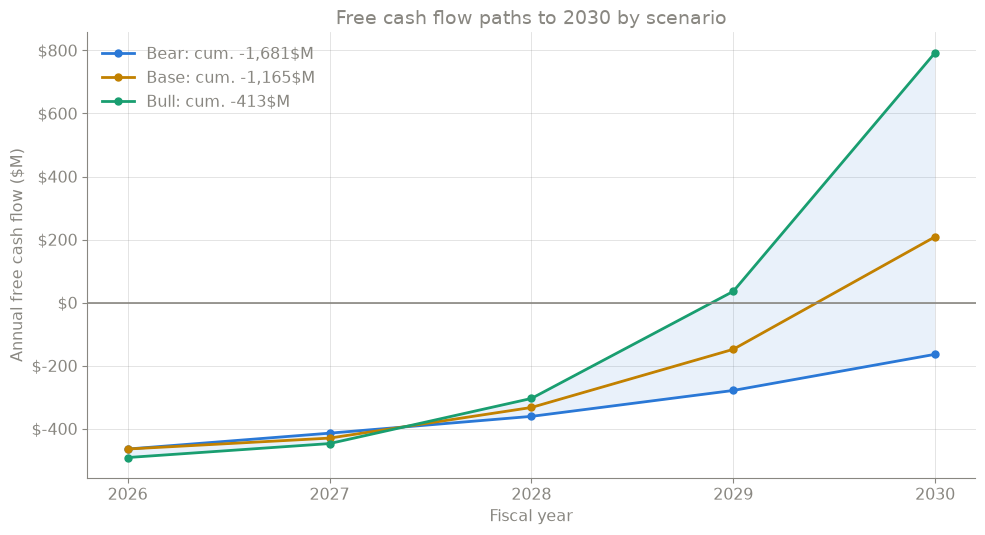
Cash flow arrives late. Base turns positive in 2030 and Bull in 2029. Bear remains negative throughout the forecast.
Base-case cumulative free cash flow is about -$1.17B from 2026–2030, meaning most of today's valuation depends on cash generation beyond the modeled period.
7. What does today's price already assume?
Figure 11
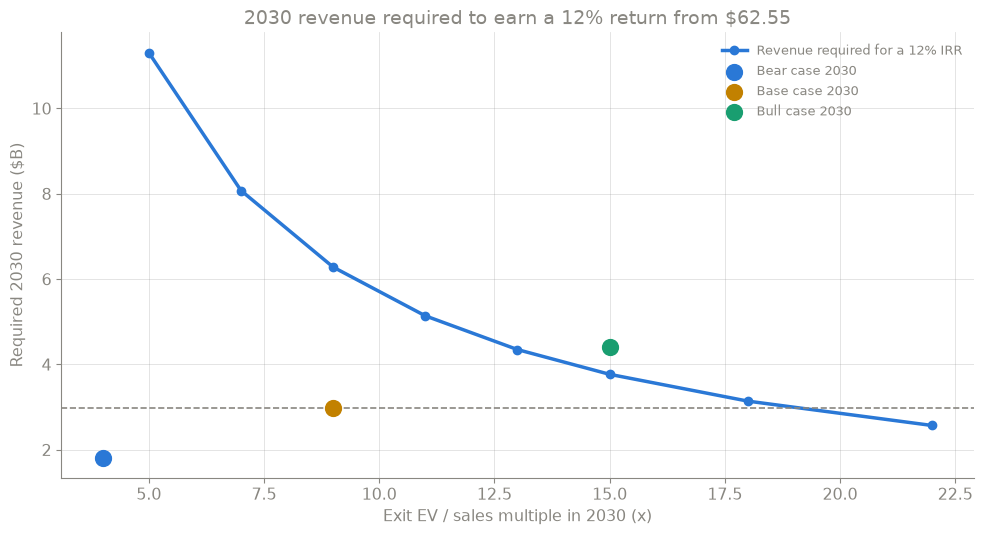
This is the key valuation test.
From the $62.55 September 15, 2026 price, earning a 12% annual return requires RKLB equity to reach roughly $59B by 2030.
At a 10x sales multiple, that requires about $5.7B of 2030 revenue — roughly 1.9x the Base case and above the $4.4B Bull case.
Even the Bull scenario needs RKLB to still trade near 13x sales in 2030 to clear that return hurdle.
So today's price assumes both strong execution and a premium valuation years from now.
Figure 12
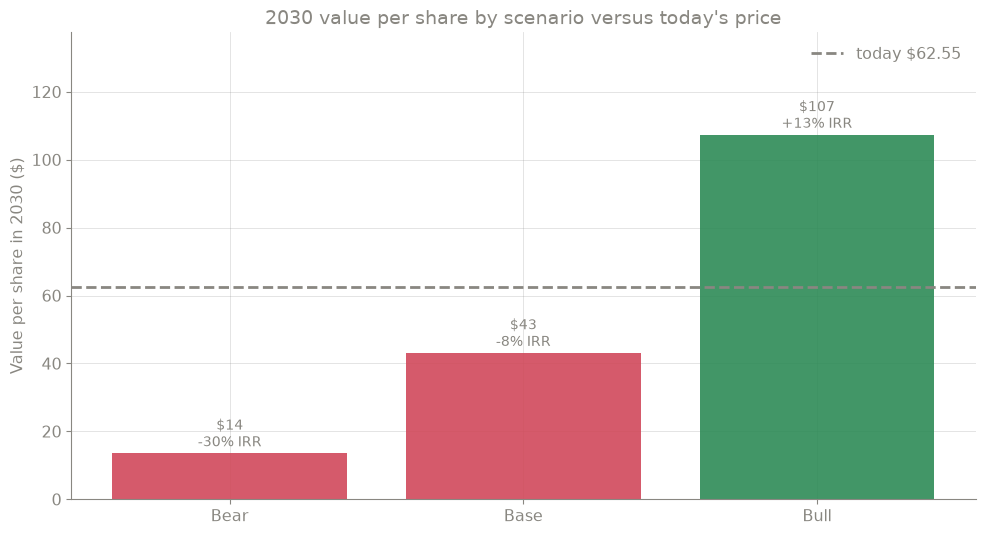
Modeled 2030 values: Bear $14, Base $43, Bull $107.
Using 30% / 50% / 20% scenario weights gives an expected value near $47, versus the $62.55 reference price.
The exact target matters less than the message: at this valuation, a lot has to go right.
8. What actually moves the valuation?
Figure 13
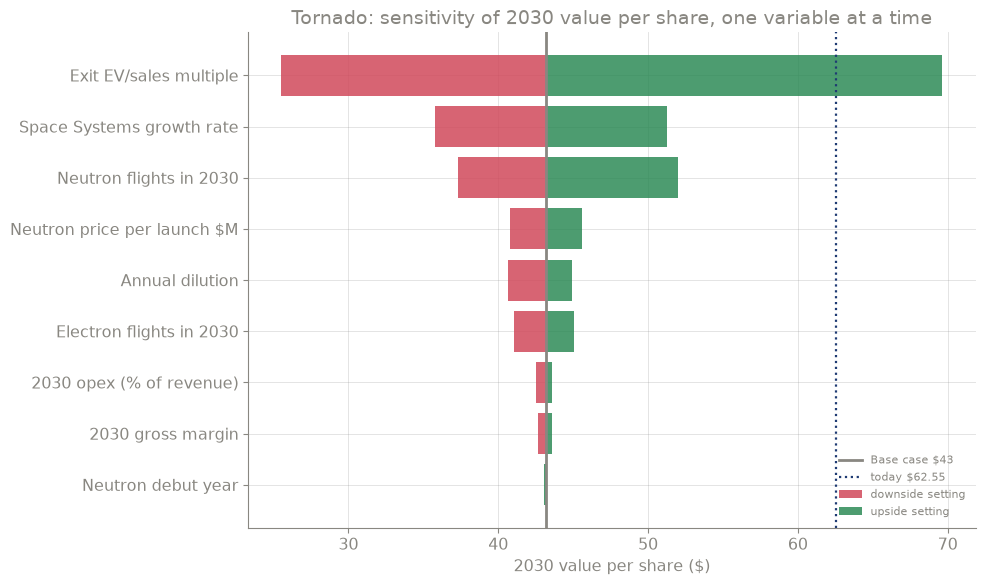
The exit multiple is the biggest sensitivity. Changing it moves modeled 2030 value from roughly $26 to $70 per share around the $43 Base case.
After that, the biggest drivers are Space Systems growth and Neutron launch cadence.
Electron cadence matters far less — another sign that Neutron and Space Systems must carry most of the future valuation.
9. What could change the picture?
The Bull case becomes more credible if Neutron launches reliably with reuse, cadence rises toward eight-plus flights a year, and Space Systems keeps growing above 30%.
Another major Neutron delay, weak reuse economics, a launch failure or slower Space Systems growth would push the revenue ramp further out.
Model notes
Neutron timing, competitor pricing, payload figures and launch economics include model assumptions rather than company guidance. The latest backlog figure used is $1.07B.
These assumptions should be treated as adjustable inputs, not disclosed facts.
Bottom line
Rocket Lab is a strong company carrying a demanding valuation.
Revenue is growing, margins are improving, Electron has proved execution, and Rocket Lab has built a real position in the space industry.
But at the $62.55 September 15, 2026 reference price, the valuation requires Neutron to scale, Space Systems to keep growing rapidly, and RKLB to retain a premium multiple.
The company has proved it can execute. Now growth has to catch up with the valuation.
Sigmo can make mistakes — verify important info. Not financial advice.
Get AlphaWeekly in your inbox
Free. New issues as they are published, with the charts and the method in view.