
Charter: Cheap Stock, Fragile Equity?
CHTR’s stock has collapsed while earnings expectations have barely moved. The reason may be hiding in its $93B debt load.
The setup
Charter Communications looks cheap after a brutal decline. But this is no longer just a story about broadband subscribers or earnings.
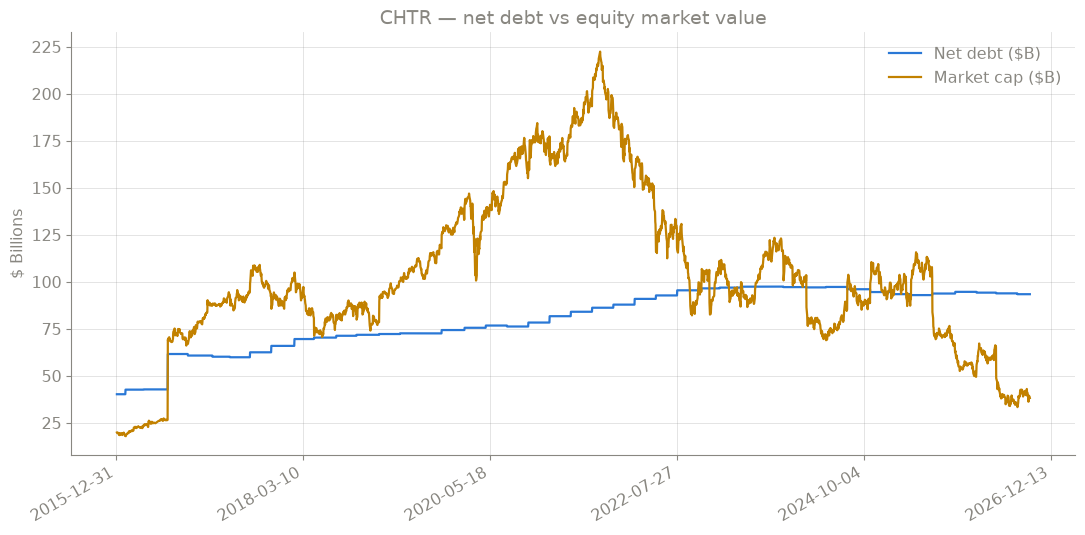
It is increasingly a leverage story. Charter carries roughly $93B of net debt against only about $38B of market value. That leaves shareholders owning a relatively thin slice of the total enterprise.
And when the equity cushion gets this small, modest changes in earnings, interest costs or valuation can produce enormous moves in the stock.
How the math changed
At Charter’s 2021 share-price peak, net debt was only about 0.4x its market value. Today it is roughly 2.4x.
The debt did not explode. The equity collapsed.
That matters because creditors now represent most of the enterprise value. A small improvement in the business can create disproportionate upside for shareholders — but deterioration works exactly the same way in reverse.
Figure 2
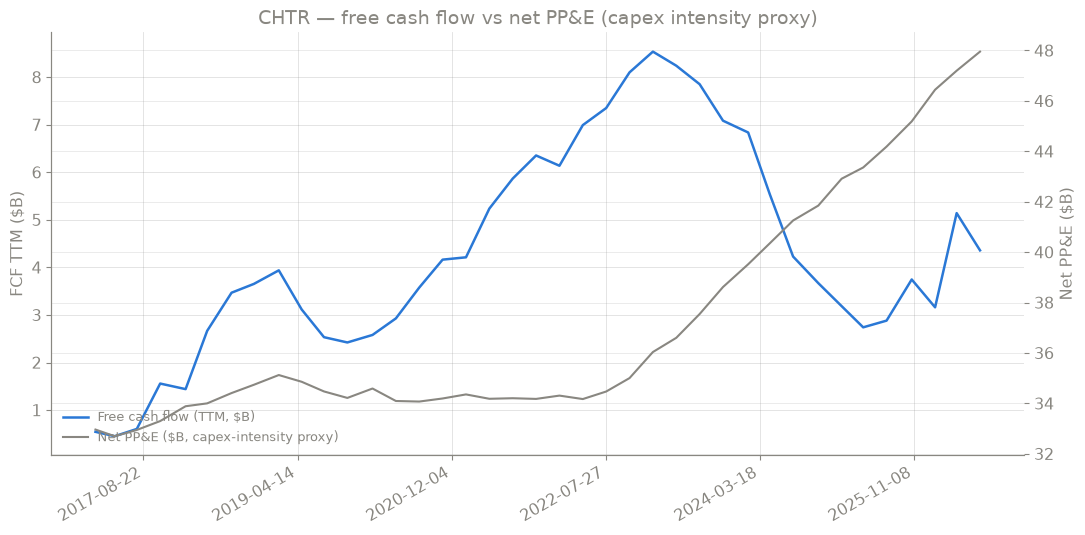
The business still produces cash
Charter still generates significant cash, but much more of it is being reinvested into the network.
Trailing free cash flow is roughly $4.4B, down from an $8.5B peak, while net property, plant and equipment has climbed from about $34B to $48B as Charter expands rural coverage and upgrades its network.
That makes one question especially important: When does capex peak? If investment spending begins falling while the operating business stabilizes, billions of dollars could eventually become available again for debt reduction or shareholder returns.
Figure 3
The refinancing problem is gradual
Charter does not appear to face one giant near-term debt wall. The risk is more gradual: refinancing old debt at higher rates year after year.
If roughly 12% of the debt stack is refinanced annually at rates 200 basis points higher, the model estimates around $220M of additional yearly interest expense. Under a harsher scenario, that could rise toward $450M.
Neither number breaks the company by itself. But each dollar spent on interest is a dollar that cannot reduce debt or return to shareholders.
Figure 4
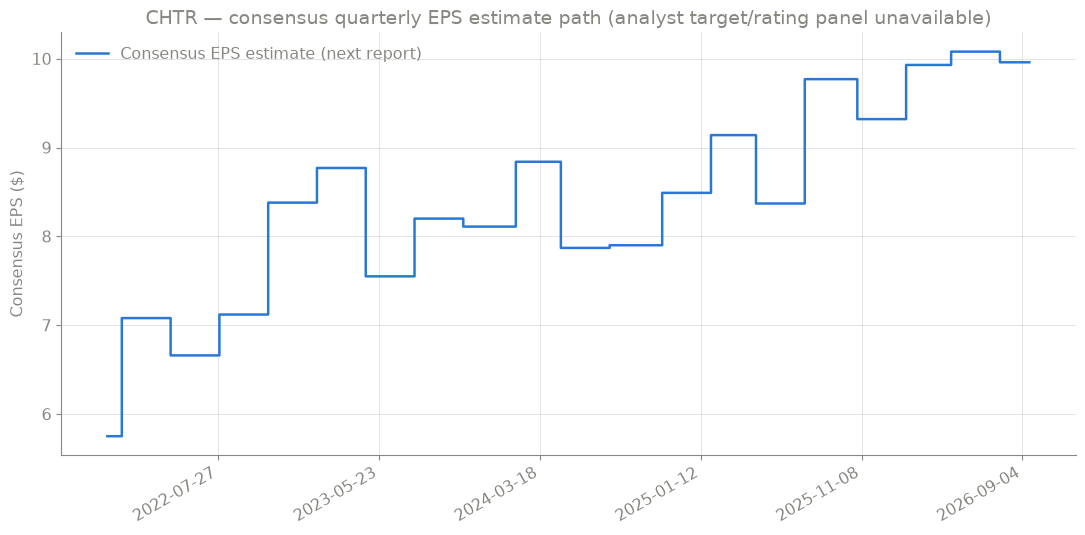
The stock fell much faster than earnings
This is where the story gets interesting.
Forward quarterly EPS consensus is near $9.96, versus $9.77 a year ago — roughly flat to slightly higher. Yet Charter’s stock has fallen about 46%.
The market is therefore pricing something much worse than current earnings estimates suggest: weaker broadband economics, persistent capital spending, higher financing costs, a lower valuation multiple — or some combination of all four.
Figure 5
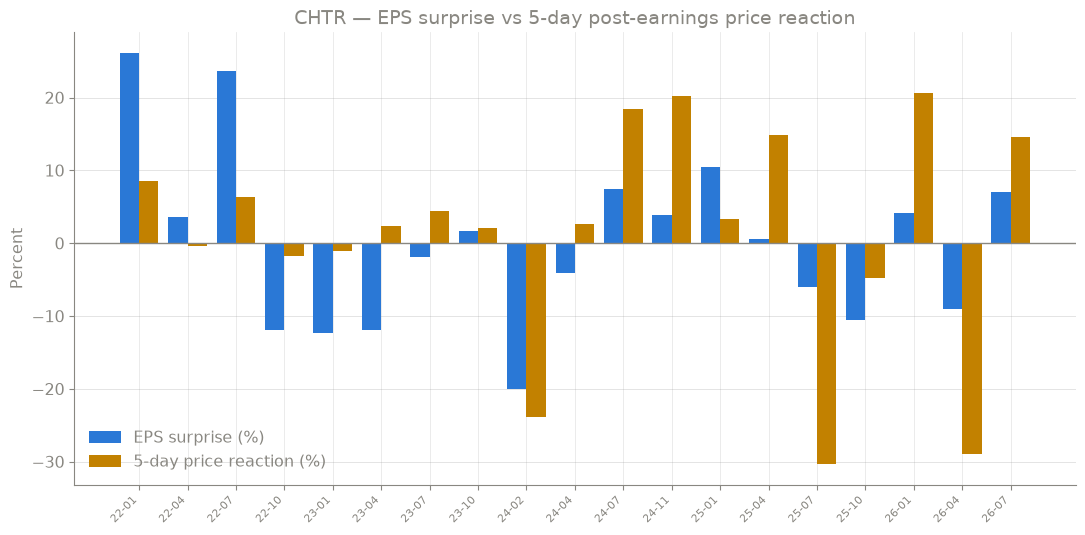
That is why another EPS beat may not be enough. Broadband trends, revenue stability and the direction of capex are likely to matter more.
Investors are already positioned defensively
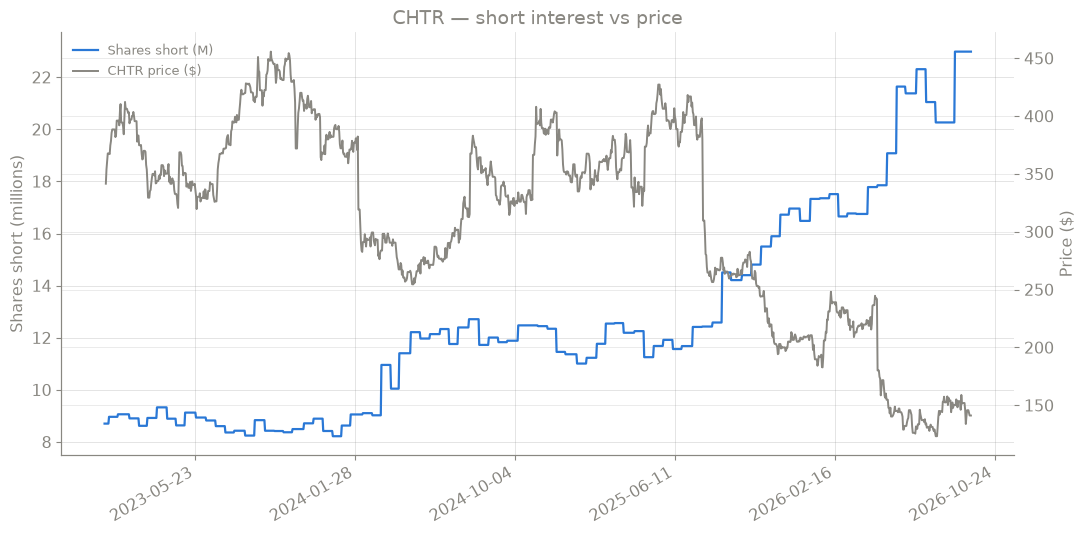
Short interest sits near 23M shares, or about 8.5% of shares outstanding, with roughly 12.3 days to cover.
That shows meaningful bearish positioning. It also creates the opposite risk: if Charter delivers an unexpected improvement, crowded shorts can amplify an upside move.
Figure 6
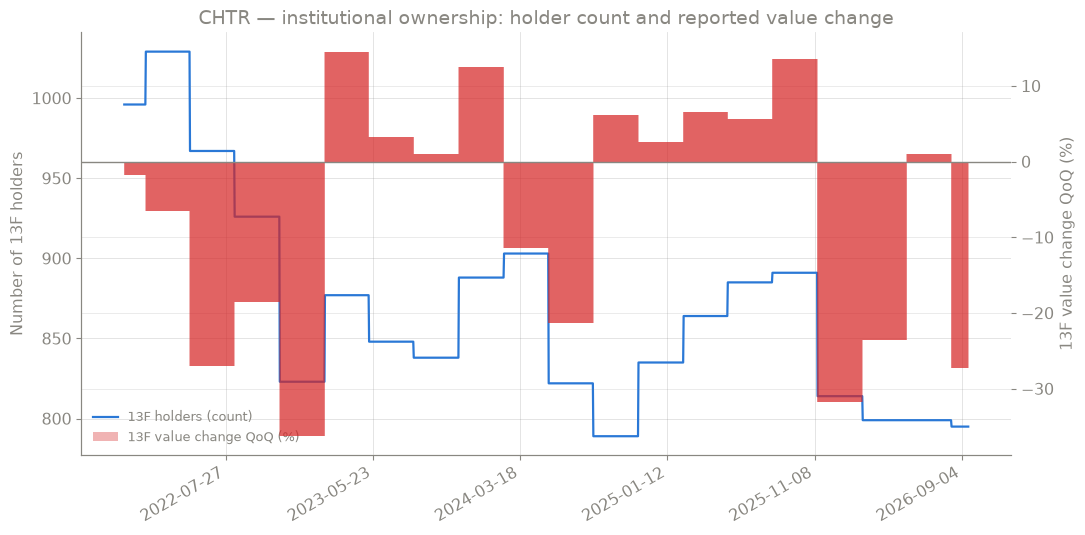
Institutional dollar exposure fell roughly 27% last quarter, although much of that reflects the falling share price rather than a wholesale exit by investors.
Figure 8
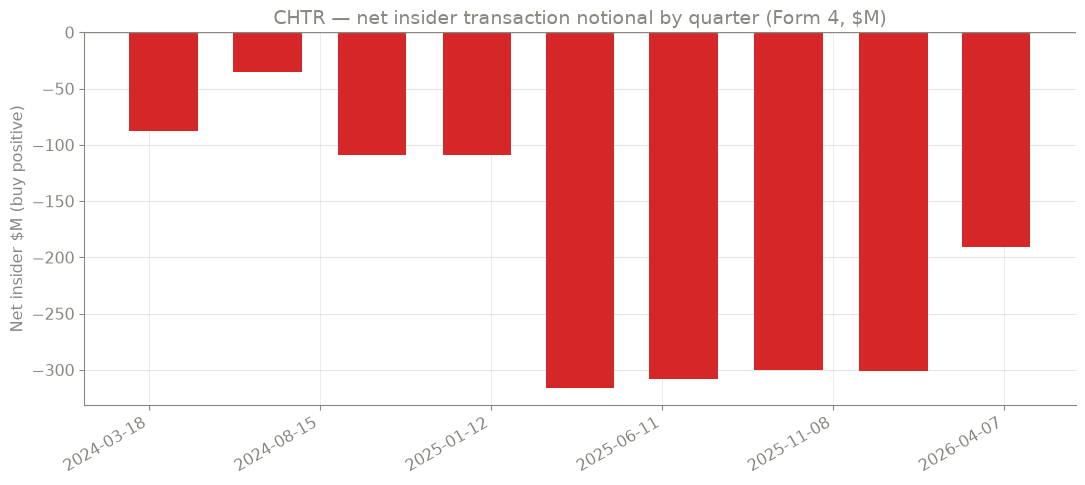
Insider filings also look negative at first glance, with roughly $1.8B of dispositions since 2024. But many of the largest transactions were Liberty Broadband-related structural transfers, making the headline figure less informative than it appears.
Figure 9
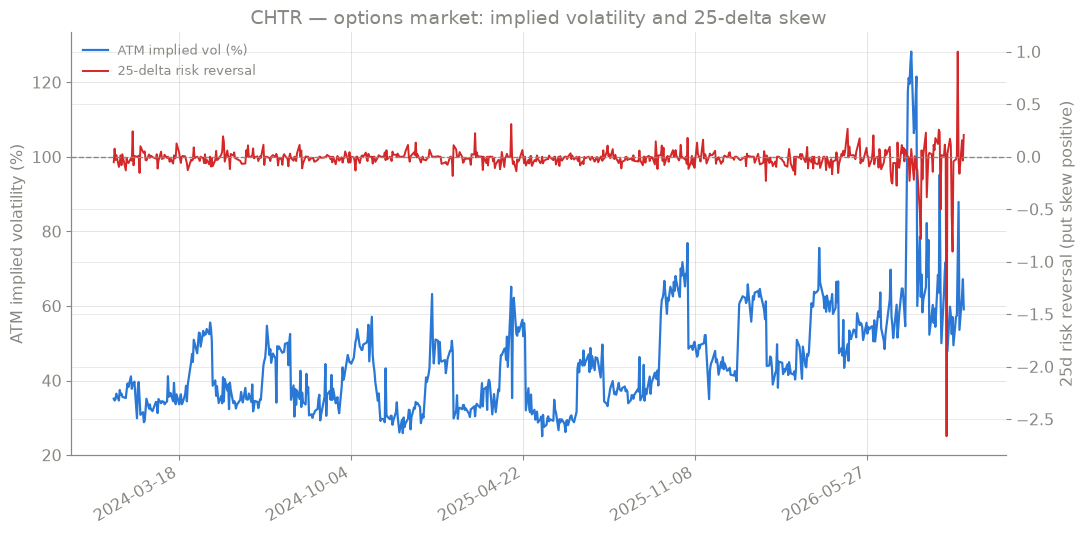
The options market is also preparing for turbulence. ATM implied volatility is around 59%, versus a two-year median near 43%, while puts trade at a premium to calls.
The market is pricing roughly a ±20% move around the next earnings report.
So what does the stock need?
Because the equity sits behind such a large debt claim, Charter does not need a dramatic operating change to produce a dramatic stock move.
Figure 10
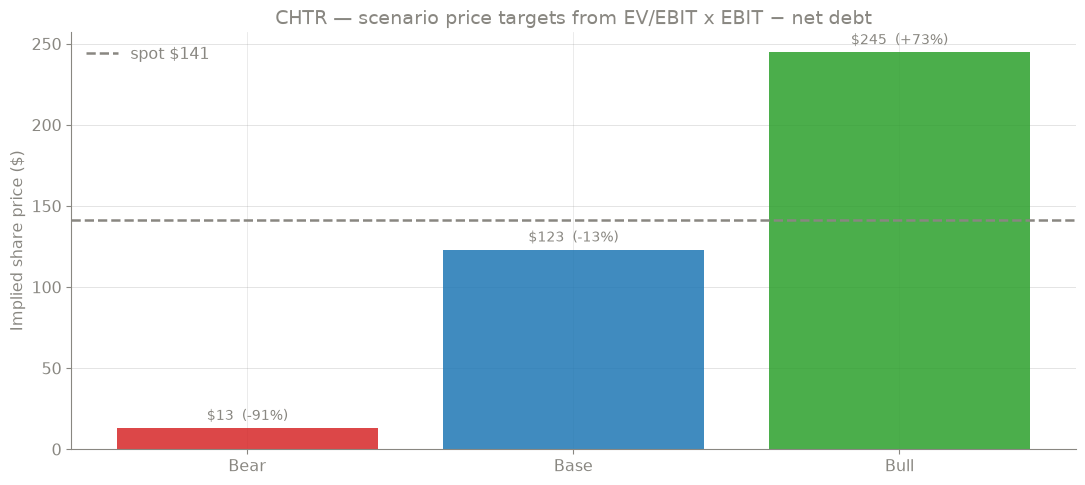
Bear case — ~$13/share: EBIT falls 10% and the valuation compresses to 8.5x.
Base case — ~$123/share: EBIT stays flat and the business holds a 10x multiple.
Bull case — ~$245/share: EBIT rises 5% and the multiple expands to 12x.
The huge spread between those outcomes is the point. Leverage magnifies relatively small changes in the underlying business.
Bottom line
Charter may be cheap, but cheap does not automatically mean low risk.
The business still generates billions in cash and earnings expectations have held up surprisingly well. The problem is that network investment, refinancing costs and an enormous debt load leave little room for disappointment.
The next chapter comes down to four things: broadband stabilization, lower capex, manageable refinancing costs and recovering free cash flow.
If those begin moving in the right direction, the same leverage hurting Charter today could become a powerful upside amplifier. If they deteriorate, shareholders remain the first part of the capital structure to feel it.
Sigmo can make mistakes — verify important info. Not financial advice.
Get AlphaWeekly in your inbox
Free. New issues as they are published, with the charts and the method in view.